From Identity to Operating System: How OneGodian™ Becomes OMOS™
From Identity to Operating System: How OneGodian™ Becomes OMOS™
Category: OMOS™
Subcategory: Identity Systems / Operating Framework
Suggested Tags: OneGodian, OMOS, OneGodian Identity, Operating System, OHI Reasoning, OneGodian Algorithm, AI Alignment, Agent Governance
Author: Gregory Lamar Jones — Founder & Author, ONEGODIAN, LLC
Platform: OMOS.Onegodian.com
Introduction
OneGodian™ begins as an identity.
OMOS™ begins when that identity becomes organized into a system.
That is the transition.
A person may first encounter OneGodian™ as a word, a belief identity, a philosophical framework, or a public statement centered on One God, One Truth, and unity. But once that identity begins to structure reasoning, documentation, tools, agents, outputs, workflows, and institutional communication, it becomes more than an identity label.
It becomes an operating system.
OMOS™ — the OneGodian Metaphysical Operating System — is the system layer that carries OneGodian™ from personal identity into structured digital, institutional, and intelligent-system architecture.
OneGodian™ names the foundation.
OMOS™ organizes the foundation into a working platform.
OneGodian™ as Identity
OneGodian™ is the identity layer.
It defines the core meaning: a founder-authored framework centered on One God, unity, and a singular source of truth. It gives language to identity, authorship, belief alignment, and public interpretation.
At the identity level, OneGodian™ answers:
Who are you?
What foundation do you stand on?
What principle organizes your worldview?
What word names your alignment with One God and One Truth?
This identity layer matters because every system needs a center.
Without identity, there is no stable point of reference.
Without a stable point of reference, the system becomes scattered.
OneGodian™ gives the system its name, origin, authorship, meaning, and foundation.
Why Identity Alone Is Not Enough
Identity is powerful, but identity by itself does not automatically create infrastructure.
A name can declare meaning.
A system must organize meaning.
That is why OneGodian™ needs OMOS™.
Without an operating layer, OneGodian™ could remain only a public identity, brand, belief statement, or philosophical concept. It could inspire posts, images, products, and conversations, but it would not yet become a repeatable system.
OMOS™ changes that.
It takes the identity and gives it structure.
It turns meaning into architecture.
It turns values into workflows.
It turns outputs into governed intelligence.
It turns the OneGodian™ body of work into a platform that can be explained, expanded, documented, and used.
What OMOS™ Adds
OMOS™ adds the system layer.
It answers a different set of questions:
How is OneGodian™ organized?
How do outputs get reviewed?
How are tools categorized?
How do agents operate?
How does content become documentation?
How does reasoning become reusable structure?
How does the platform maintain consistency over time?
OMOS™ gives OneGodian™ operational form through:
identity standards,
alignment rules,
OHI Reasoning,
model synthesis,
documentation systems,
tool architecture,
agent workflows,
timekeeping overlays,
artifact libraries,
digital products,
and governed outputs.
This is the shift from concept to system.
From Word to Framework
The first stage is the word.
OneGodian™ provides a clear linguistic anchor. It names a unity-centered identity and gives the public a simple way to understand the foundation.
The second stage is the framework.
Once the word is defined, documented, and applied across writings, products, platforms, and institutional explanations, it becomes more than a term. It becomes a structured body of work.
The third stage is the operating system.
When the framework begins to govern tools, outputs, dashboards, AI interactions, agent workflows, and platform architecture, it becomes OMOS™.
That progression is important:
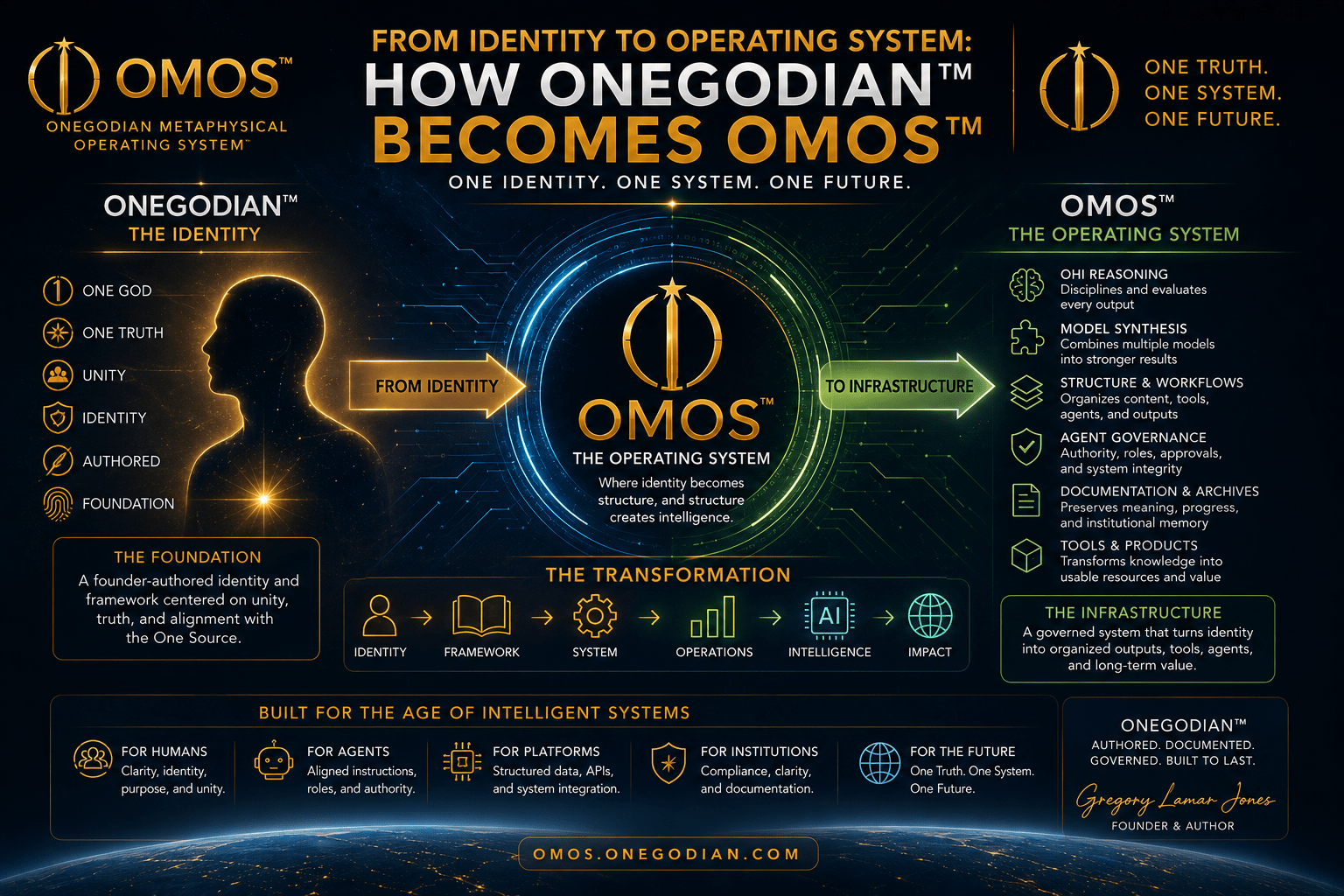
Word → Identity → Framework → Operating System
OneGodian™ is the identity.
OMOS™ is the operating environment built from that identity.
OMOS™ as the OneGodian System Layer
OMOS™ does not replace OneGodian™.
It extends it.
OneGodian™ is the source identity. OMOS™ is the structured environment that allows the identity to operate across digital and intelligent systems.
In practical terms:
OneGodian™ defines the foundation.
OMOS™ organizes the platform.
The OneGodian Algorithm™ governs alignment.
OHI Reasoning evaluates outputs.
The dashboard exposes system activity.
The tools make the framework usable.
The artifacts preserve proof of development.
The documentation explains the structure.
The shop distributes products.
The agents extend execution.
Together, these parts move OneGodian™ from identity into infrastructure.
The Role of the OneGodian Algorithm™
The OneGodian Algorithm™ is the logic layer that helps OMOS™ operate.
It gives the system a way to evaluate options, outputs, workflows, and decisions by asking whether they increase truth, clarity, coherence, dignity, and constructive unity.
That matters because an operating system cannot be built only from ideas.
It needs decision logic.
The OneGodian Algorithm™ provides that logic.
OMOS™ applies it.
The result is a system that can process raw inputs, compare outputs, reduce noise, organize knowledge, and produce structured OneGodian Intelligence.
The Role of OHI Reasoning
OHI Reasoning is the review and synthesis discipline inside OMOS™.
It is what prevents raw AI output from becoming official system output too quickly.
A chatbot may answer a question.
OHI Reasoning asks whether that answer is clear, aligned, structured, accurate, and usable.
That is why OMOS™ is not just a chatbot. It is a reasoning environment.
It uses OHI Reasoning to turn:
prompts into workflows,
answers into assets,
conversations into documentation,
ideas into tools,
model outputs into synthesis,
and content into structured intelligence.
This is how OneGodian™ becomes operational.
Identity Becomes Platform
The moment OneGodian™ becomes OMOS™, the work moves from identity expression into platform development.
That means every part of the ecosystem needs a place.
Posts belong to categories.
Tools belong to modules.
Documents belong to archives.
Products belong to the shop.
Agents belong to roles.
Outputs belong to workflows.
Decisions belong to logs.
Updates belong to the roadmap.
OMOS™ creates that place.
It turns the OneGodian™ ecosystem into something users can navigate, developers can build, agents can operate within, and institutions can understand.
Why This Matters for AI and Agents
AI systems need structure.
Agents need rules.
Platforms need governance.
Without an operating framework, AI tools can become scattered assistants producing disconnected outputs. With OMOS™, those outputs can be reviewed, classified, aligned, and placed inside a larger system.
This is especially important for agent workflows.
An agent should not simply act because it can. It should operate within a defined authority model, task structure, approval boundary, and logging standard.
OMOS™ provides the conceptual platform for that discipline.
It moves OneGodian™ into the AI era not as a slogan, but as a governed operating architecture.
The Public Meaning of the Transition
For the public, this transition should be understood clearly.
OneGodian™ is the identity and authored body of work.
OMOS™ is the operating system that organizes the work into public pages, tools, documentation, outputs, resources, dashboards, and intelligent-system workflows.
That means OMOS™ is not a separate identity competing with OneGodian™.
It is the platform expression of OneGodian™.
OneGodian™ answers the question of meaning.
OMOS™ answers the question of structure.
The Institutional Meaning of the Transition
For institutions, OMOS™ should be presented as a structured platform and operating framework connected to the OneGodian™ body of work.
It should not be framed as a civil authority, legal substitute, financial authority, or external governing body.
Its proper institutional classification is stronger and clearer:
OMOS™ is a digital operating framework for organizing OneGodian™ identity, documentation, reasoning, tools, outputs, products, and intelligent-system alignment.
That is defensible.
That is practical.
That is scalable.
Practical Example
A person may begin with the statement:
“I am OneGodian.”
That is identity.
Then the system asks:
What does that identity mean?
How is it documented?
How is it explained publicly?
How does AI classify it?
How are tools built around it?
How are outputs governed?
How are members, readers, agents, and systems guided?
That is OMOS™.
The identity becomes a platform when it can structure activity beyond the statement itself.
Final Statement
OneGodian™ becomes OMOS™ when identity becomes operational.
The identity gives the system its foundation.
OMOS™ gives the foundation structure.
It organizes the OneGodian™ body of work into a platform for reasoning, documentation, tools, agents, outputs, artifacts, products, and intelligent-system governance.
That is the transformation:
from word to identity,
from identity to framework,
from framework to operating system,
from operating system to governed intelligence.
OneGodian™ is the foundation. OMOS™ is the system. The future runs on One Truth, One System, and One Future.
Call to Action
Explore the OMOS™ platform at OMOS.Onegodian.com.
Follow the updates, review the tools, study the framework, and watch how OneGodian™ continues moving from identity into a structured operating system for the intelligent systems era.