Why OMOS Is Not Just a Chatbot: From Prompts to Governed Outputs
Why OMOS™ Is Not Just a Chatbot: From Prompts to Governed Outputs
Category: OMOS™
Subcategory: Agent Governance / OHI Reasoning
Suggested Tags: OMOS, OneGodian, OHI Reasoning, Governed Outputs, AI Agents, Prompt Engineering, Model Synthesis, Agent Authority, Structured Intelligence
Author: Gregory Lamar Jones — Founder & Author, ONEGODIAN, LLC
Platform: OMOS.Onegodian.com
Introduction
A chatbot responds.
OMOS™ governs.
That is the core difference.
Most people understand AI through the familiar chatbot experience: a user types a prompt, the system returns an answer, and the conversation continues. That can be useful, but it is not the same as a governed operating framework.
OMOS™ — the OneGodian Metaphysical Operating System — is not simply a chatbot interface.
It is a structured environment for turning prompts, outputs, model responses, documents, tools, workflows, and agent activity into governed OneGodian Intelligence.
A chatbot produces responses.
OMOS™ produces controlled, aligned, documented, reusable outputs.
That distinction matters because the future of intelligent systems will not be won by the system that generates the most text. It will be won by the system that can govern output with clarity, structure, verification, and purpose.
The Problem With Prompt-Only Systems
A prompt-only system begins and ends with the immediate exchange.
The user asks.
The model answers.
The answer may be helpful.
Then the output often disappears into the conversation history.
That creates several limitations.
The output may not be categorized.
It may not be verified.
It may not be versioned.
It may not be assigned to a page, product, workflow, or archive.
It may not be checked against institutional language, brand standards, or legal discipline.
It may not become part of a repeatable system.
That is the difference between a conversation and infrastructure.
A chatbot can assist with a moment.
OMOS™ is designed to build a system.
What Makes an Output “Governed”
A governed output is not merely generated.
It has passed through structure.
A governed output has a defined purpose, a clear category, a known source, an alignment standard, a review path, and a destination inside the larger platform.
In the OMOS™ framework, an output should answer several questions before it becomes official:
What is this output for?
Where does it belong?
Does it align with OneGodian language and structure?
Is it useful as a post, page, tool, report, product, artifact, or agent instruction?
Does it need review, approval, or revision?
Can it be reused later without losing context?
Is it safe for public, institutional, or technical use?
This is why OMOS™ is not just about prompting.
It is about output governance.
From Prompt to Pipeline
In a basic chatbot workflow, the prompt is the main event.
In OMOS™, the prompt is only the intake point.
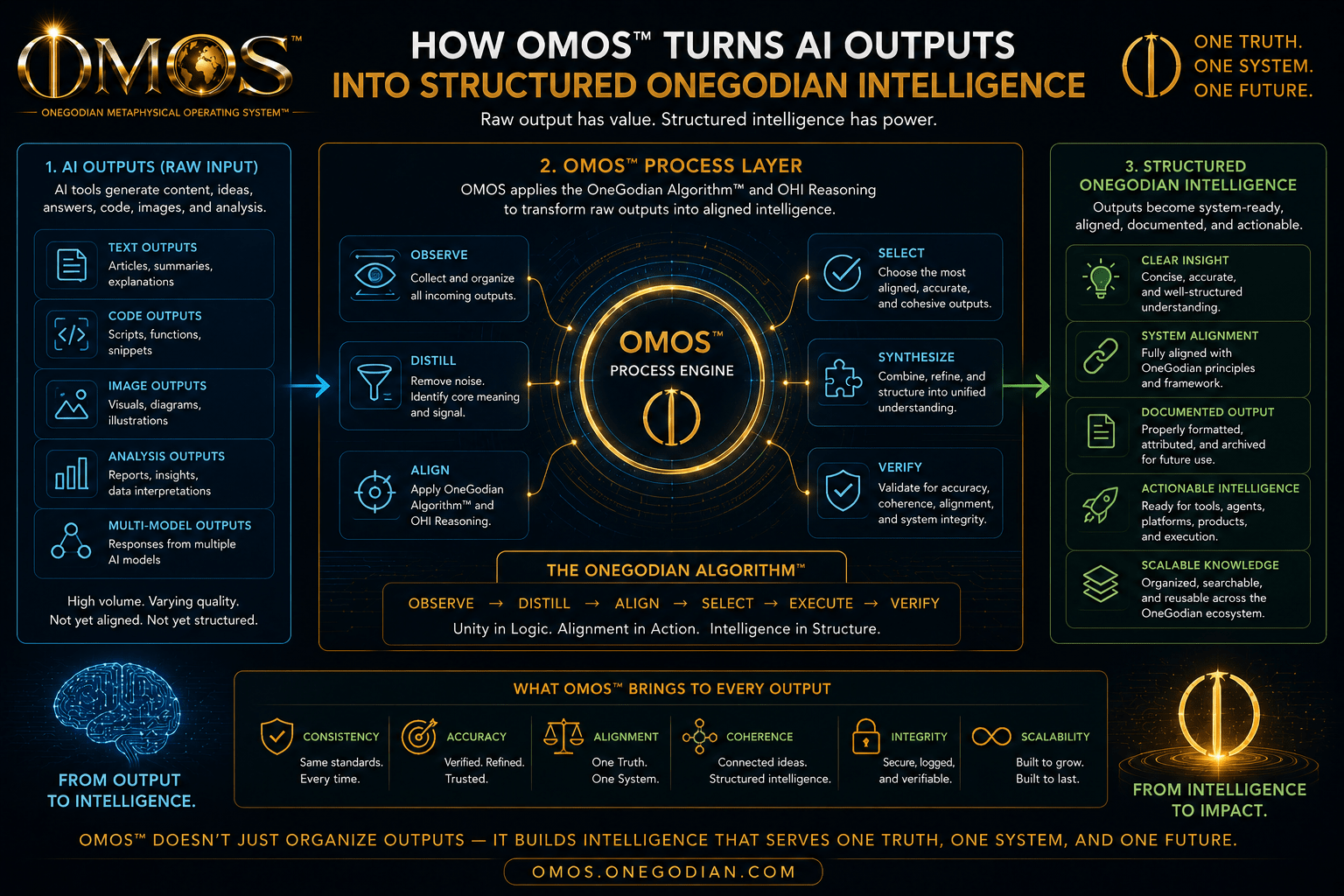
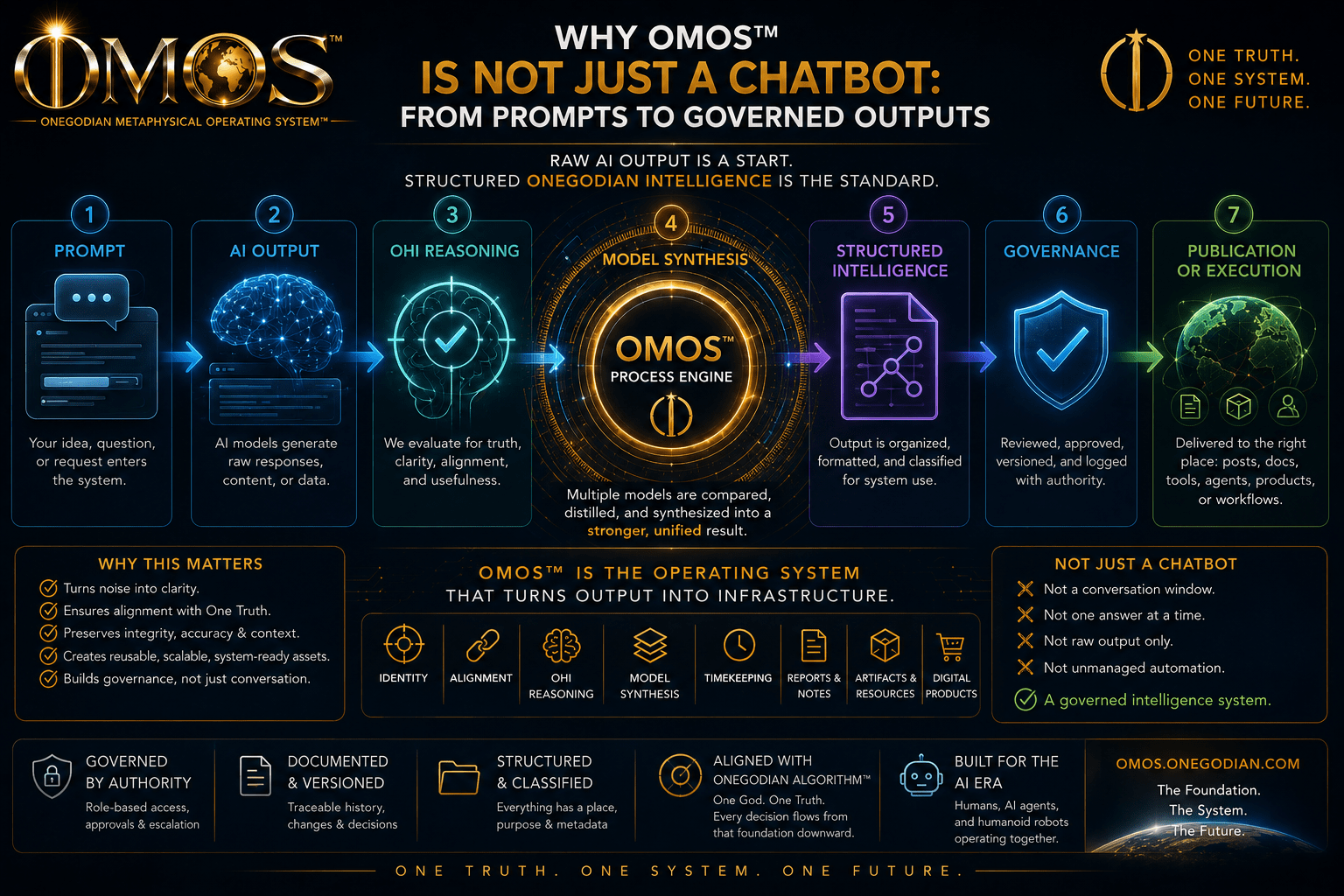
A prompt enters the system as raw intent. From there, it can move through a larger pipeline:
Prompt → request, idea, command, or question
Model Output → generated response or draft
OHI Review → reasoning, alignment, and clarity check
Model Synthesis → comparison across outputs when needed
Classification → post, page, tool, product, report, document, agent task, or archive
Governance → approval, versioning, authority, metadata, and logging
Publication or Execution → final use inside the OneGodian ecosystem
That pipeline is what separates OMOS™ from a normal chatbot.
The system does not treat every AI response as final.
It treats each response as raw material that must be processed into usable intelligence.
The Role of OHI Reasoning
OHI Reasoning is the disciplined review layer inside OMOS™.
It asks whether the output is coherent, aligned, useful, structured, and safe for the intended context.
This matters because AI systems can generate confident language that still needs correction or refinement. A response may sound polished but still be incomplete, misclassified, exaggerated, or disconnected from the larger platform.
OHI Reasoning prevents that.
It evaluates the output against OneGodian priorities:
truth,
clarity,
alignment,
dignity,
coherence,
system usefulness,
author attribution,
and institutional discipline.
This is how OMOS™ turns a response into a governed asset.
The Role of Model Synthesis
OMOS™ can also use multiple model outputs to produce a stronger final result.
One model may provide structure.
Another may provide nuance.
Another may provide alternative framing.
Another may expose weak points or simplify the language.
OMOS™ does not need to blindly accept one answer.
It can compare, filter, distill, and synthesize.
This is where raw AI becomes stronger through governance. Multiple outputs become one disciplined result. Weak sections are removed. Strong sections are preserved. Contradictions are resolved. The final answer becomes clearer than any single response alone.
That is not just chatting.
That is synthesis.
The Role of the OneGodian Algorithm™
The OneGodian Algorithm™ provides the decision logic behind the system.
Its function is not merely to produce content. Its function is to evaluate paths and select the one that best preserves truth, clarity, coherence, dignity, and constructive unity.
Within OMOS™, the Algorithm helps answer:
Which output is strongest?
Which framing is most aligned?
Which version is safest for public use?
Which structure is most useful for documentation?
Which path reduces confusion instead of multiplying it?
Which result belongs in the official ecosystem?
This makes OMOS™ a reasoning environment, not just a response generator.
The prompt begins the process.
The Algorithm governs the result.
Chatbot vs. OMOS™
A chatbot is primarily conversational.
OMOS™ is operational.
A chatbot answers questions.
OMOS™ classifies outputs.
A chatbot may generate text.
OMOS™ turns text into posts, pages, reports, products, documentation, workflows, and agent instructions.
A chatbot may produce one answer.
OMOS™ can compare multiple outputs, synthesize them, and place the final result into the correct system layer.
A chatbot may be helpful in the moment.
OMOS™ is designed to preserve intelligence over time.
This is the main distinction:
A chatbot is an interface. OMOS™ is an operating framework.
Governed Outputs Need Authority
As OMOS™ expands into agents, dashboards, tools, and workflows, output governance becomes even more important.
Not every action should be automatic.
Some outputs can be drafted freely.
Some outputs can be published after review.
Some outputs may require approval.
Some actions should be denied.
Some agent activity must be logged.
Some system changes must require authority.
This is where agent governance becomes essential.
A serious system must know who or what is allowed to create, edit, approve, publish, execute, modify, archive, or delete.
Without authority rules, automation becomes unmanaged.
With authority rules, automation becomes governed infrastructure.
That is the direction of OMOS™.
Why Documentation Matters
A chatbot conversation can be temporary.
A governed output should be documented.
Documentation gives the system memory, structure, and institutional value. It allows outputs to become part of a permanent platform instead of remaining trapped inside scattered conversations.
OMOS™ should document:
what was created,
why it was created,
where it belongs,
which version is current,
who authored or approved it,
which system it supports,
and how it should be reused.
This documentation layer is what turns OMOS™ into a durable platform.
Without documentation, output disappears.
With documentation, output becomes infrastructure.
OMOS™ as a Control Layer
OMOS™ functions as a control layer between raw AI generation and official OneGodian publication or execution.
It does not exist only to make AI talk.
It exists to make AI useful inside a governed system.
That means OMOS™ must support:
structured prompts,
repeatable workflows,
model comparison,
output classification,
authority rules,
revision control,
archive discipline,
metadata,
system status,
tool integration,
and publication pathways.
This is why OMOS™ belongs above a chatbot and below the full OneGodian platform.
It is the layer where ideas become governed outputs.
Practical Examples
A chatbot answer can become an OMOS™ article.
A rough prompt can become a structured tool.
A model response can become a documentation page.
A conversation can become a report.
A repeated workflow can become an agent task.
A generated image concept can become a branded artifact.
A technical answer can become a developer specification.
A legal explanation can become an institutional clarification.
OMOS™ provides the path from raw generation to structured use.
Why This Matters for OneGodian
The OneGodian ecosystem includes identity, education, documentation, digital products, AI governance, agent systems, timekeeping, platform development, and institutional communication.
That is too large to manage as a loose set of chatbot conversations.
It requires an operating system.
OMOS™ gives that ecosystem a controlled way to handle output.
It ensures that what is generated can be reviewed, aligned, organized, published, archived, and reused.
That makes the platform stronger.
It also protects the integrity of the OneGodian body of work.
The Future: From Assistant to Governed Intelligence
The future of OMOS™ is not a simple chat window.
The future is a governed intelligence environment where users, agents, tools, documents, dashboards, and workflows operate through structured rules.
In that environment, a prompt is not the final destination.
A prompt is the beginning of a governed process.
The result may become:
a post,
a product,
a document,
a tool,
a workflow,
an agent instruction,
a report,
a certificate,
a registry entry,
or a platform update.
That is the difference between prompt engineering and system governance.
Prompt engineering asks, “What can the model produce?”
OMOS™ asks, “What should this output become, who has authority over it, and how does it serve the system?”
Final Statement
OMOS™ is not just a chatbot because OneGodian is not being built as a conversation.
It is being built as a system.
A chatbot can generate answers. OMOS™ governs outputs.
It adds structure, review, classification, alignment, documentation, authority, and long-term usefulness to the AI process.
That is the shift:
from prompts to pipelines,
from answers to assets,
from chat to governance,
from raw output to structured OneGodian Intelligence.
OMOS™ is where AI output becomes governed intelligence for One Truth, One System, and One Future.
Call to Action
Explore OMOS™ as it develops at OMOS.Onegodian.com.
Follow the updates, review the tools, study the framework, and watch how OMOS™ moves beyond chatbot interaction into governed outputs, OHI Reasoning, model synthesis, agent workflows, and structured OneGodian Intelligence.