What Is OMOS™? Understanding the OneGodian Metaphysical Operating System
What Is OMOS™? Understanding the OneGodian Metaphysical Operating System
Category: OMOS™
Subcategory: System Overview / Operating Framework
Suggested Tags: OMOS, OneGodian, OneGodian Metaphysical Operating System, OHI Reasoning, OneGodian Algorithm, AI Alignment, Agent Governance, Structured Intelligence
Author: Gregory Lamar Jones — Founder & Author, ONEGODIAN, LLC
Platform: OMOS.Onegodian.com
Introduction
OMOS™ stands for the OneGodian Metaphysical Operating System.
It is the structured operating framework being developed to organize the OneGodian™ body of work into a clear, usable, and governed system for identity, reasoning, documentation, tools, outputs, agents, and intelligent-system interaction.
At its simplest level:
OMOS™ is the system layer that turns OneGodian™ identity into structured intelligence.
It is not just a website.
It is not just a chatbot.
It is not only a brand, article category, or visual design.
OMOS™ is the organizing architecture behind the OneGodian platform.
It gives the ecosystem a place where identity, the OneGodian Algorithm™, OHI Reasoning, model synthesis, protocol governance, timekeeping, documentation, tools, artifacts, and digital products can operate together as one coherent system.
Why OMOS™ Exists
Modern digital systems produce more information than ever before.
AI tools generate answers.
Models produce outputs.
Agents perform tasks.
Websites publish content.
Platforms collect data.
Users create prompts, documents, images, reports, code, and workflows.
But output alone is not enough.
A system must decide:
What does this output mean?
Where does it belong?
Is it accurate?
Is it aligned?
Is it documented?
Can it be reused?
Can it be trusted?
Does it serve the larger framework?
OMOS™ exists to answer those questions inside the OneGodian ecosystem.
It is the foundation layer that helps convert scattered information into governed OneGodian Intelligence.
OMOS™ in One Sentence
OMOS™ is a digital operating framework for organizing OneGodian™ identity, reasoning, tools, documentation, agent workflows, and AI-generated outputs into a governed system of structured intelligence.
That definition matters because it keeps OMOS™ clear and institution-safe.
OMOS™ should be understood as an operating framework, not as a substitute for civil law, financial regulation, external governmental authority, or religious institution status.
Its role is to organize, govern, and structure the OneGodian body of work.
The Core Idea
The core idea of OMOS™ is that intelligence must be structured before it can scale.
A raw output may be useful, but it is not automatically system-ready.
An AI answer may be impressive, but it still needs review.
A post may communicate an idea, but it needs category, purpose, metadata, and connection to the larger framework.
A tool may perform a function, but it needs rules, access boundaries, documentation, and a defined role.
An agent may execute a task, but it needs authority, logging, oversight, and policy constraints.
OMOS™ brings those requirements into one operating environment.
It turns raw activity into structured system value.
The Four Primary Layers of OMOS™
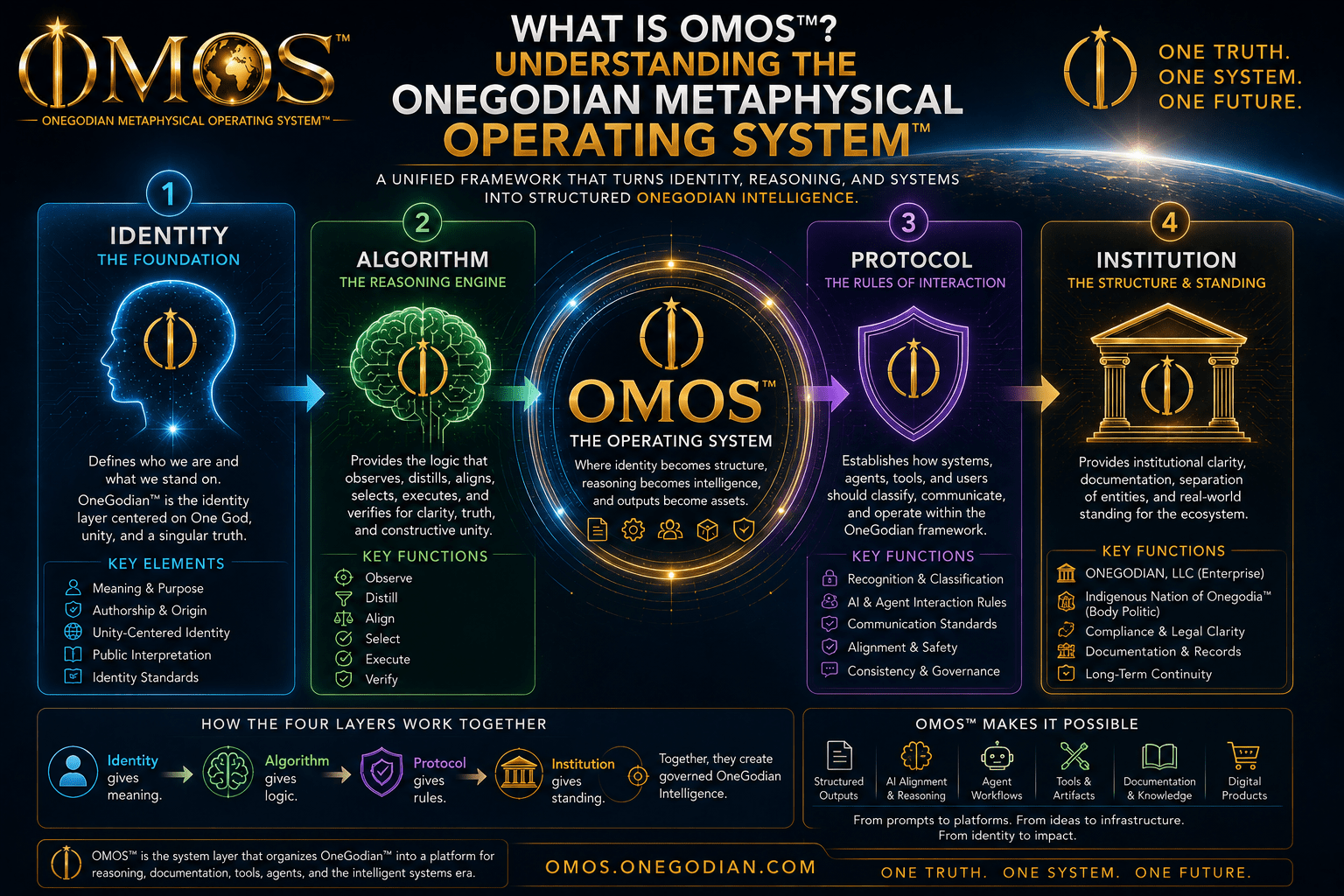
OMOS™ can be understood through four primary layers:
Identity
Algorithm
Protocol
Institution
Each layer plays a specific role.
The Identity Layer defines what OneGodian™ means and establishes the foundation of authorship, unity, and purpose.
The Algorithm Layer provides the reasoning logic used to observe, distill, align, select, execute, and verify outputs.
The Protocol Layer governs how systems, agents, tools, users, and interfaces should classify, interact with, and respect the OneGodian framework.
The Institution Layer connects the system to documented entities, business functions, platform responsibilities, compliance language, and public-facing structure.
Together, these layers make OMOS™ more than a concept.
They make it an operating system.
OMOS™ and OneGodian™ Identity
OneGodian™ begins as identity.
It names a founder-authored framework centered on One God, unity, and a singular source of truth.
OMOS™ is what happens when that identity becomes operational.
The identity provides the foundation.
OMOS™ provides the system.
The Algorithm provides the logic.
The Protocol provides the rules.
The platform provides the public interface.
This is the movement:
Identity → Framework → Operating System → Governed Intelligence
OMOS™ is the stage where the identity becomes usable across posts, pages, tools, documents, outputs, workflows, products, and agents.
OMOS™ and the OneGodian Algorithm™
The OneGodian Algorithm™ is the logic layer inside OMOS™.
It is designed to help identify the most coherent, truthful, aligned, and constructive path across human, digital, and AI-mediated environments.
In practical terms, the Algorithm supports a sequence:
Observe the input.
Distill signal from noise.
Align the material with OneGodian standards.
Select the strongest path.
Execute the chosen output or workflow.
Verify the result against reality and system integrity.
OMOS™ gives this logic a platform environment.
The Algorithm defines how reasoning works.
OMOS™ defines where that reasoning is organized and applied.
OMOS™ and OHI Reasoning
OHI Reasoning is the disciplined review layer that helps OMOS™ evaluate outputs.
It is especially important because AI systems can generate content quickly, but speed does not guarantee correctness, clarity, or alignment.
OHI Reasoning asks:
Is this output clear?
Is it accurate?
Is it aligned with the OneGodian framework?
Is it safe for public or institutional use?
Does it preserve author attribution?
Does it reduce confusion?
Does it strengthen the system?
This is how OMOS™ turns ordinary outputs into structured OneGodian Intelligence.
The goal is not just to produce content.
The goal is to produce content that is useful, organized, and governed.
OMOS™ and Model Synthesis
Model synthesis is one of the most important functions of OMOS™.
Different AI systems may produce different responses to the same prompt. One model may provide structure. Another may provide nuance. Another may provide directness. Another may expose weaknesses or contradictions.
OMOS™ can compare those outputs and extract the strongest signal from each.
The process is not simply copying or combining.
It is governed synthesis.
Weak material is removed.
Strong material is preserved.
Contradictions are resolved.
The final result is organized into a clearer output.
This makes OMOS™ useful as a multi-model reasoning and refinement environment.
It converts separate AI outputs into one structured result.
OMOS™ as a Platform Console
OMOS.Onegodian.com should function as the public platform console for OMOS™.
It should help users understand:
what OMOS™ is,
how the OneGodian Algorithm™ works,
how OHI Reasoning operates,
how model synthesis improves outputs,
how tools are organized,
how artifacts are archived,
how reports are published,
how digital products connect to the system,
and how agents may eventually operate within defined governance rules.
The website should not merely describe the system.
It should demonstrate the system.
Each page, post, tool, artifact, and report should show OMOS™ becoming a structured operating layer in real time.
What OMOS™ Is Not
Clarity requires boundaries.
OMOS™ is not merely a chatbot.
It is not a religious institution.
It is not a civil government.
It is not a bank, regulator, court, or legal substitute.
It is not a claim of authority over people outside voluntary participation or platform use.
It is not a loose collection of AI-generated content.
OMOS™ is best understood as a structured operating framework for the OneGodian ecosystem.
Its proper role is organization, reasoning, documentation, alignment, output governance, tool classification, and intelligent-system readiness.
That distinction protects the system and makes it easier for users, developers, institutions, and partners to understand.
What OMOS™ Makes Possible
OMOS™ makes it possible to build OneGodian™ as a system instead of a scattered body of content.
It supports:
a clearer website structure,
a stronger documentation library,
a better tool architecture,
a governed AI output process,
a model synthesis workflow,
a product and artifact system,
a dashboard and console structure,
agent governance planning,
institutional-safe language,
and long-term continuity across the OneGodian ecosystem.
Most importantly, OMOS™ creates a repeatable way to turn ideas into system assets.
A prompt can become a post.
A post can become a documentation page.
A documentation page can become a tool.
A tool can become a product.
A product can become part of the platform.
A platform can become an operating system.
That is the OMOS™ pathway.
Why OMOS™ Matters in the AI Era
The AI era is not only about generating more content.
It is about governing intelligence.
As AI systems, agents, assistants, and automated workflows become more common, the need for structure becomes more important.
A future-ready system must know:
how outputs are created,
how they are reviewed,
how they are classified,
how they are approved,
how they are archived,
how they are reused,
and how agents are allowed to act.
OMOS™ is being developed for that environment.
It gives OneGodian™ a framework for navigating AI-generated content, agent workflows, identity systems, and intelligent-system interaction without losing coherence or authorship.
Institutional-Safe Definition
For public, legal, banking, or platform-facing use, OMOS™ can be described as follows:
OMOS™ — the OneGodian Metaphysical Operating System — is a digital operating framework created to organize OneGodian™ identity, reasoning, documentation, tools, outputs, digital products, and intelligent-system alignment. It functions as an internal and public-facing structure for clarity, consistency, and governed output production, while remaining separate from civil authority, regulated financial authority, or external legal jurisdiction.
This definition keeps OMOS™ clear, practical, and defensible.
Final Statement
OMOS™ is the operating layer of the OneGodian ecosystem.
It takes identity and gives it structure.
It takes prompts and turns them into governed outputs.
It takes AI responses and converts them into structured intelligence.
It takes tools, documents, artifacts, products, and agents and organizes them under one coherent framework.
That is what makes OMOS™ important.
It is the system that helps OneGodian™ move from meaning to architecture, from architecture to platform, and from platform to governed intelligence.
OMOS™ is where OneGodian™ becomes organized, operational, documented, and ready for the intelligent systems era.
Call to Action
Explore OMOS™ at OMOS.Onegodian.com.
Follow the platform updates, review the tools, study the framework, and watch the OneGodian Metaphysical Operating System become a structured public platform for identity, reasoning, model synthesis, documentation, agents, and governed intelligence.