Align: OneGodian Algorithm
Align: The OneGodian Algorithm™
Category: OMOS™
Subcategory: OneGodian Algorithm™ / Alignment Systems
Suggested Tags: Align, OneGodian Algorithm, OMOS, OHI Reasoning, Alignment, Identity Systems, Model Synthesis, Structured Intelligence
Author: Gregory Lamar Jones — Founder & Author, ONEGODIAN, LLC
Platform: OMOS.Onegodian.com
Introduction
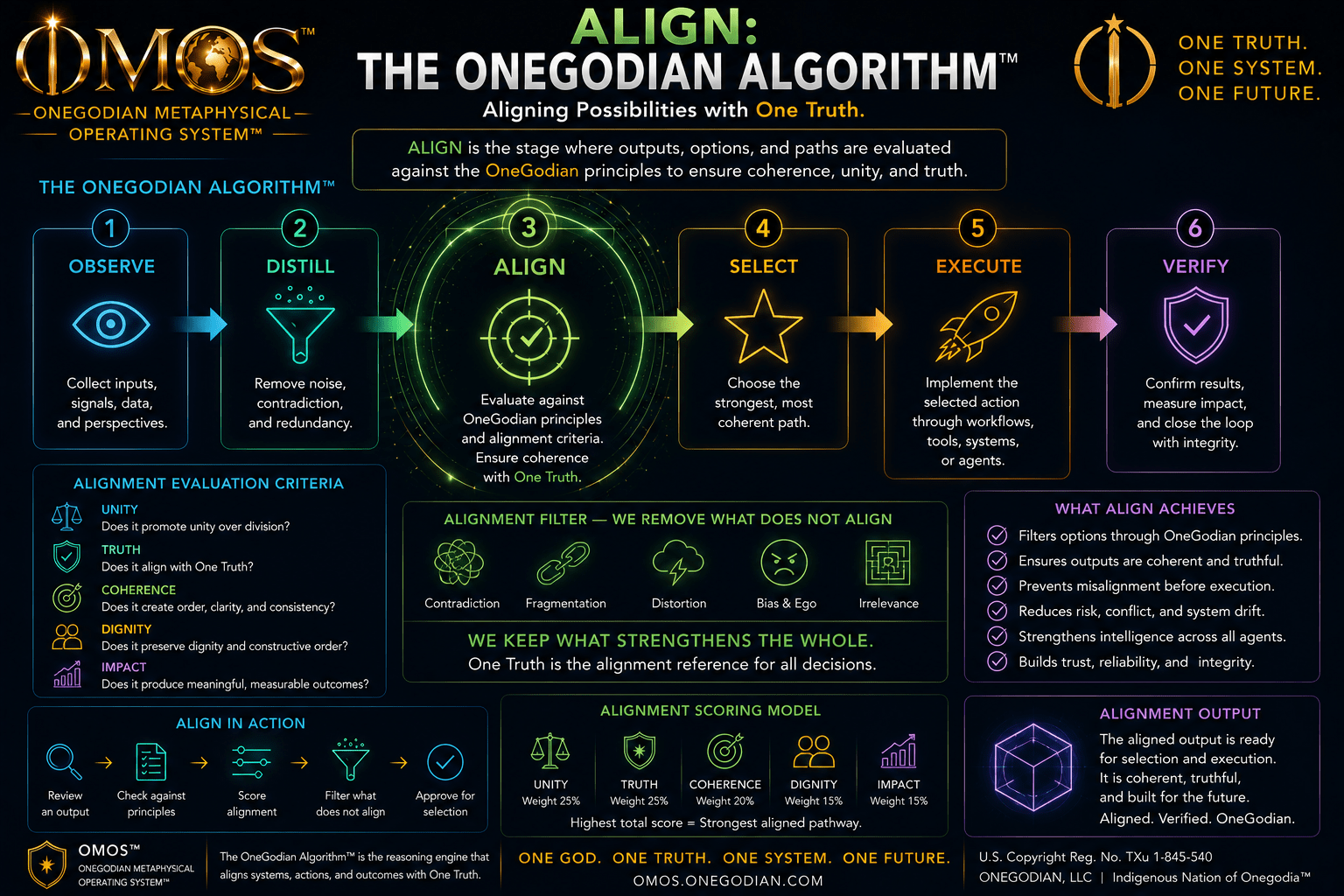
Within the OneGodian Algorithm™, Align is the phase where information, outputs, reasoning, and possible actions are evaluated against the governing principles of the framework before operational selection occurs.
It follows:
- Observe
- Distill
- Align
- Select
- Execute
- Verify
Inside OMOS™, Align functions as the coherence checkpoint between:
- raw interpretation
- and governed decision-making.
The purpose of Align is to ensure that:
- reasoning,
- workflows,
- outputs,
- and operational paths
remain consistent with:
- clarity,
- coherence,
- integrity,
- constructive unity,
- and framework continuity.
What “Align” Means in the OneGodian Framework
Alignment within the OneGodian Algorithm™ is the process of testing whether a signal, interpretation, output, workflow, or proposed action fits the governing structure of the system.
The Align phase asks:
- Does this reduce fragmentation?
- Does this increase clarity?
- Does this preserve integrity?
- Does this remain coherent with the framework?
- Does this strengthen constructive order?
- Does this support truthful and usable outcomes?
Alignment acts as the stabilization layer before:
selection and execution.
Alignment as an OMOS™ Layer
Inside OMOS™, Align functions as:
- a coherence layer,
- an integrity filter,
- a synthesis checkpoint,
- and a governance preparation stage.
This phase evaluates:
- outputs,
- workflows,
- reasoning chains,
- agent actions,
- reports,
- documentation,
- and operational decisions
before they are approved for selection and execution.
Without alignment:
- execution becomes unstable,
- outputs become contradictory,
- and systems drift into fragmentation.
Alignment creates:
continuity before action.
The OneGodian Alignment Sequence
The operational flow is:
1. Observe
Collect signals, prompts, and inputs.
2. Distill
Reduce contradiction, noise, and redundancy.
3. Align
Evaluate coherence against governing principles.
4. Select
Choose the strongest aligned pathway.
5. Execute
Implement the selected action.
6. Verify
Confirm measurable outcomes and integrity.
The Align phase acts as the:
bridge between interpretation and governed selection.
What the Align Phase Evaluates
Inside OMOS™, the Align layer may evaluate:
1. Content Alignment
Determining whether:
- posts,
- reports,
- synthesis outputs,
- educational materials,
- and documentation
remain:
- coherent,
- useful,
- institution-safe,
- and framework-consistent.
2. Workflow Alignment
Evaluating:
- operational pathways,
- automation logic,
- escalation structures,
- routing decisions,
- and governance chains.
3. Agent Alignment
Determining whether:
- AI agents,
- workflows,
- and automated systems
operate within:
- approved authority scopes,
- policy boundaries,
- and governed constraints.
This aligns directly with ACC™, OCP™, and governed execution architecture.
4. Model Synthesis Alignment
In multi-model reasoning systems:
- multiple outputs may exist,
- but alignment identifies which outputs remain coherent with the governing framework.
This includes:
- contradiction reduction,
- signal extraction,
- coherence comparison,
- and synthesis evaluation.
Alignment Is Not Blind Agreement
The Align phase does not require uniformity of perspective.
The framework recognizes:
- multiple viewpoints,
- multiple outputs,
- and multiple pathways.
Alignment evaluates whether:
- the system remains coherent,
- fragmentation is reduced,
- and the outputs remain constructively usable.
This distinction matters.
Alignment is not:
- forced conformity,
- ideological erasure,
- or suppression of complexity.
It is:
coherence through structured evaluation.
Alignment and Identity
Identity acts as the foundational reference point for alignment.
Within the OneGodian framework:
- outputs,
- workflows,
- and operational systems
should remain coherent with:
- the OneGodian Principle,
- documented positioning,
- institutional clarity,
- and framework continuity.
Alignment disconnected from identity creates fragmentation.
Alignment rooted in identity creates operational consistency.
Alignment and OHI Reasoning
OHI Reasoning operates heavily inside the Align phase.
This includes evaluating:
- clarity,
- truthfulness,
- coherence,
- operational usefulness,
- ethical integrity,
- and synthesis quality.
OHI Reasoning helps determine:
- whether outputs should proceed,
- whether refinement is needed,
- or whether contradiction remains unresolved.
This transforms OMOS™ from:
raw output generation
into:
governed reasoning infrastructure.
Alignment in Multi-Model Synthesis
One of the clearest examples of Align occurs during comparative AI synthesis.
Different AI systems may produce:
- different reasoning chains,
- conflicting outputs,
- or fragmented interpretations.
The Align phase then:
- compares outputs,
- extracts shared signal,
- reduces contradiction,
- and identifies coherence patterns.
This aligns directly with the GCD-style synthesis logic described in the OHI framework.
The objective becomes:
unity through disciplined alignment.
Alignment and Governance
Alignment must remain governed.
Without governance:
- alignment becomes subjective,
- execution becomes unstable,
- and operational systems drift.
Inside OMOS™, alignment connects directly to:
- policy rules,
- authority boundaries,
- workflow constraints,
- and execution governance.
This relates to the governed execution spine:
ACC™ → OCP™ → OEG™ → Adapters / Runners
Within this structure:
- ACC™ coordinates intake,
- OCP™ authorizes actions,
- OEG™ routes execution,
- and operational systems perform the work.
Alignment acts as the integrity checkpoint before:
selection and execution.
Alignment and Verification
Alignment is not the same as verification.
Alignment asks:
“Is this coherent with the governing framework?”
Verification asks:
“Did the executed result produce measurable coherent outcomes?”
The distinction is critical.
Alignment prepares the path.
Verification measures the outcome.
Institutional Positioning
The Align phase should be understood as:
- a coherence evaluation layer,
- a reasoning integrity process,
- a governance preparation stage,
- and a structured synthesis mechanism.
It is not:
- governmental authority,
- legal arbitration,
- or unrestricted AI control.
The framework is designed for:
- platform systems,
- educational systems,
- intelligent-system governance,
- workflow coordination,
- and operational reasoning environments.
Short Definition
Align in the OneGodian Algorithm™ is the governed evaluation phase where outputs, workflows, reasoning, and operational pathways are tested for coherence, integrity, and continuity before selection and execution occur inside the OMOS™ framework.
OMOS™ Alignment Principle
Observe the signal.
Distill the noise.
Align the framework.
Select the strongest path.
Execute with structure.
Verify against reality.
Final Statement
The Align phase is where OMOS™ stabilizes:
- reasoning,
- workflows,
- synthesis outputs,
- and operational direction
before:
selection and execution occur.
It acts as the:
coherence checkpoint of the OneGodian Algorithm™.
Inside the framework, alignment is not blind agreement.
It is:
governed continuity designed to preserve clarity, coherence, integrity, and constructive order across intelligent systems and operational infrastructure.
OMOS™ provides the environment. The OneGodian Algorithm™ provides the reasoning logic. Align ensures the system remains coherent before action moves forward.
There are no comments