

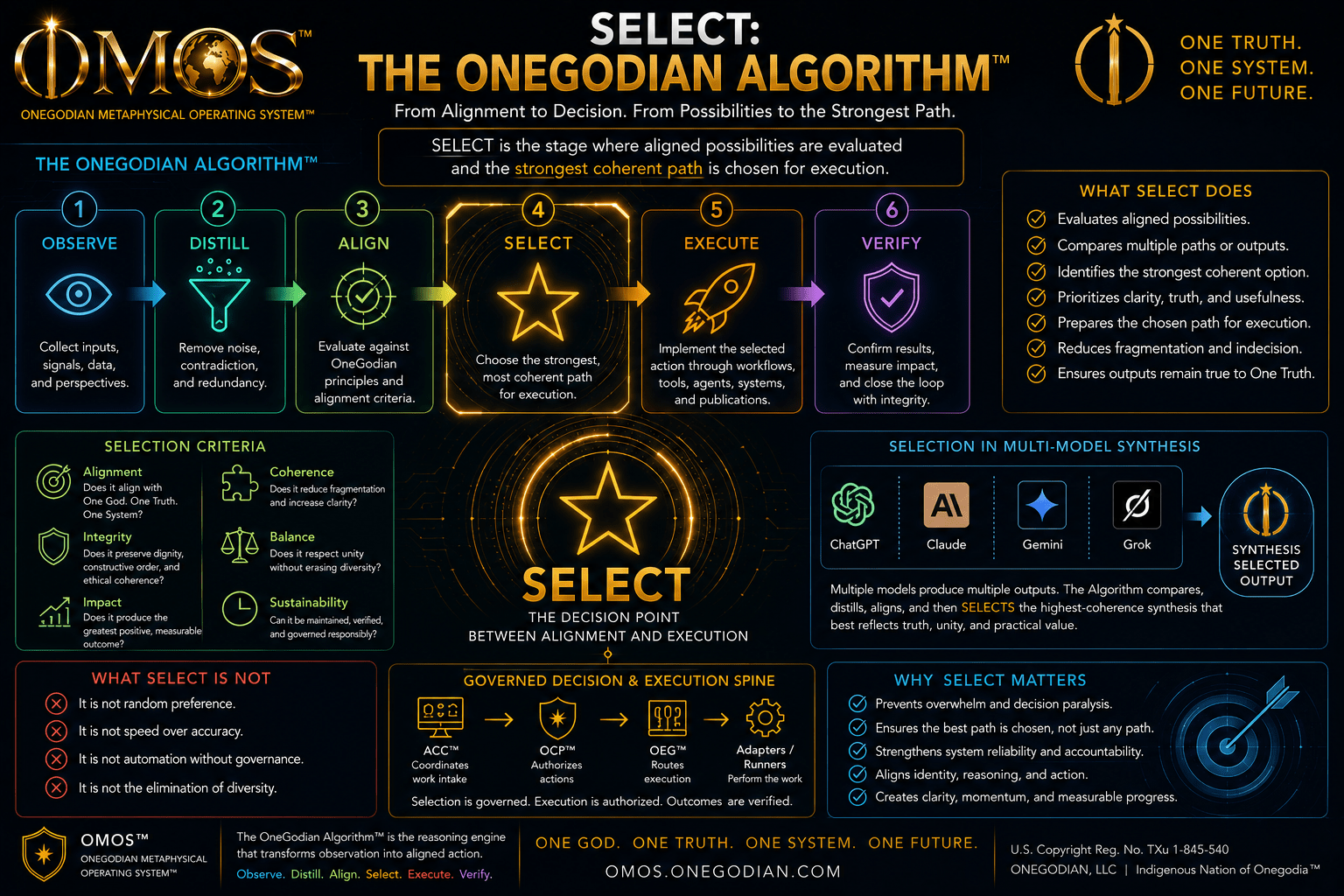
Select: OneGodian Algorithm
Select: The OneGodian Algorithm™
Category: OMOS™
Subcategory: OneGodian Algorithm™ / Selection Systems
Suggested Tags: Select, OneGodian Algorithm, OMOS, OHI Reasoning, Alignment, Workflow Governance, Model Synthesis, Structured Intelligence
Author: Gregory Lamar Jones — Founder & Author, ONEGODIAN, LLC
Platform: OMOS.Onegodian.com
Introduction
Within the OneGodian Algorithm™, Select is the phase where aligned possibilities are narrowed into a chosen operational path.
It follows:
- Observe
- Distill
- Align
- Select
- Execute
- Verify
The Select phase exists because not every possible action, output, interpretation, or workflow should move forward simply because it exists.
Inside OMOS™, Select functions as the decision layer between alignment and execution.
It transforms:
- possibilities
- alternatives
- synthesized outputs
- and operational pathways
into:
- one chosen direction ready for governed implementation.
What “Select” Means in the OneGodian Framework
Selection within the OneGodian Algorithm™ is the process of identifying the strongest coherent pathway after:
- observation,
- distillation,
- and alignment have already occurred.
The Select phase asks:
- Which path best preserves clarity?
- Which output is most coherent?
- Which action reduces fragmentation?
- Which interpretation aligns with the framework?
- Which workflow best supports constructive outcomes?
- Which operational route should move forward?
Selection is therefore not random preference.
It is:
governed prioritization through aligned reasoning.
Selection as an OMOS™ Layer
Inside OMOS™, Select acts as:
- a routing layer,
- prioritization layer,
- synthesis resolution layer,
- and governance checkpoint.
This phase determines:
- which outputs become official,
- which workflows are activated,
- which reports are preserved,
- which tasks are routed,
- and which actions proceed toward execution.
Without selection:
- systems remain overloaded with unresolved possibilities,
- outputs remain fragmented,
- and execution becomes unstable.
Selection creates operational direction.
The OneGodian Selection Sequence
The operational flow is:
1. Observe
Collect signals and inputs.
2. Distill
Reduce contradiction and informational noise.
3. Align
Evaluate against governing principles.
4. Select
Choose the strongest coherent pathway.
5. Execute
Implement the selected action.
6. Verify
Measure and confirm outcomes.
The Select phase acts as the gateway between:
alignment → execution.
What the System Selects
Inside OMOS™, the Select layer may govern:
1. Content Selection
Choosing:
- which reports publish,
- which posts move forward,
- which documentation becomes canonical,
- which synthesis outputs become official records.
2. Workflow Selection
Determining:
- which operational pathway activates,
- which task chain proceeds,
- which approval route applies,
- which automation triggers.
3. Model Selection
In comparative AI synthesis:
- multiple outputs may exist,
- but the system selects the strongest aligned result.
This includes:
- coherence analysis,
- contradiction reduction,
- signal extraction,
- and synthesis prioritization.
4. Agent Routing Selection
Determining:
- which agent handles a task,
- which authority scope applies,
- which escalation path activates,
- which execution permissions are granted.
This aligns with ACC™, OCP™, and governed execution architecture.
Selection and Alignment
Selection only occurs after alignment.
This is a foundational principle inside the OneGodian framework.
The system does not prioritize:
- speed over coherence,
- volume over clarity,
- or automation over integrity.
Instead, selection attempts to identify:
- the strongest coherent path
- with the least fragmentation
- and the highest constructive integrity.
This means the Select phase evaluates:
- clarity,
- consistency,
- truthfulness,
- governance compliance,
- institutional safety,
- and operational usefulness.
Selection Is Not Elimination of Diversity
The Select phase does not assume that only one perspective exists.
Instead, the framework recognizes:
- multiple perspectives,
- multiple outputs,
- multiple interpretations,
- and multiple pathways.
Selection occurs after:
- comparison,
- synthesis,
- and alignment evaluation.
The purpose is not suppression.
The purpose is:
operational coherence.
Selection in Multi-Model Synthesis
One of the clearest examples of the Select phase appears in model synthesis.
Multiple AI systems may generate:
- different conclusions,
- different structures,
- different reasoning chains,
- or conflicting outputs.
The OneGodian Algorithm™ then:
- compares them,
- removes instability,
- identifies common signal,
- and selects the strongest aligned synthesis.
This aligns with the GCD-style synthesis logic documented inside the OHI framework.
The objective becomes:
unity through disciplined selection.
Selection and Governance
Selection without governance creates bias and instability.
Inside OMOS™, selection therefore depends on:
- authorization structures,
- policy controls,
- approval boundaries,
- operational constraints,
- and auditability.
This connects directly to the governed execution spine:
ACC™ → OCP™ → OEG™ → Adapters / Runners
Within this structure:
- ACC™ coordinates intake,
- OCP™ authorizes actions,
- OEG™ routes execution,
- and adapters perform operational work.
Selection acts as the prioritization and routing intelligence between alignment and execution.
Selection and Identity
Selection must remain consistent with foundational identity.
Within the OneGodian framework:
- outputs,
- workflows,
- and operational decisions
should remain aligned with:
- the OneGodian Principle,
- framework coherence,
- documented positioning,
- and institutional clarity.
Selection disconnected from identity creates fragmentation.
Selection aligned with identity creates continuity.
Institutional Positioning
The Select phase should be understood as:
- a reasoning and prioritization layer,
- a synthesis governance process,
- a workflow routing mechanism,
- and an operational decision framework.
It is not:
- governmental authority,
- legal arbitration,
- or unrestricted autonomous AI decision-making.
The framework is designed for:
- platform systems,
- intelligent-system coordination,
- educational environments,
- workflow governance,
- and structured operational infrastructure.
Short Definition
Select in the OneGodian Algorithm™ is the governed decision phase where aligned possibilities are evaluated and the strongest coherent pathway is chosen for operational execution inside the OMOS™ framework.
OMOS™ Selection Principle
Observe the signal.
Distill the noise.
Align the framework.
Select the strongest path.
Execute with structure.
Verify against reality.
Final Statement
The Select phase is where OMOS™ transforms:
- aligned possibilities
- synthesized outputs
- and structured reasoning
into:
- chosen operational direction.
It acts as the decision bridge between:
alignment → execution.
Inside the OneGodian Algorithm™, selection is not arbitrary preference.
It is:
governed prioritization designed to reduce fragmentation, strengthen coherence, and support constructive execution.
OMOS™ provides the operating environment. The OneGodian Algorithm™ provides the reasoning logic. Select determines which aligned pathway becomes operational reality.
There are no comments