The Four Layers of OMOS™: Identity, Algorithm, Protocol, and Institution
The Four Layers of OMOS™: Identity, Algorithm, Protocol, and Institution
Category: OMOS™
Subcategory: System Architecture / Operating Framework
Suggested Tags: OMOS, OneGodian, Identity Layer, OneGodian Algorithm, OneGodian Protocol, Institution, AI Governance, OHI Reasoning
Author: Gregory Lamar Jones — Founder & Author, ONEGODIAN, LLC
Platform: OMOS.Onegodian.com
Introduction
OMOS™ is not a single tool.
It is not only a website.
It is not only a chatbot, prompt system, or content engine.
OMOS™ — the OneGodian Metaphysical Operating System — is a layered operating framework that organizes OneGodian™ identity, reasoning, governance, documentation, and institutional structure into one coherent system.
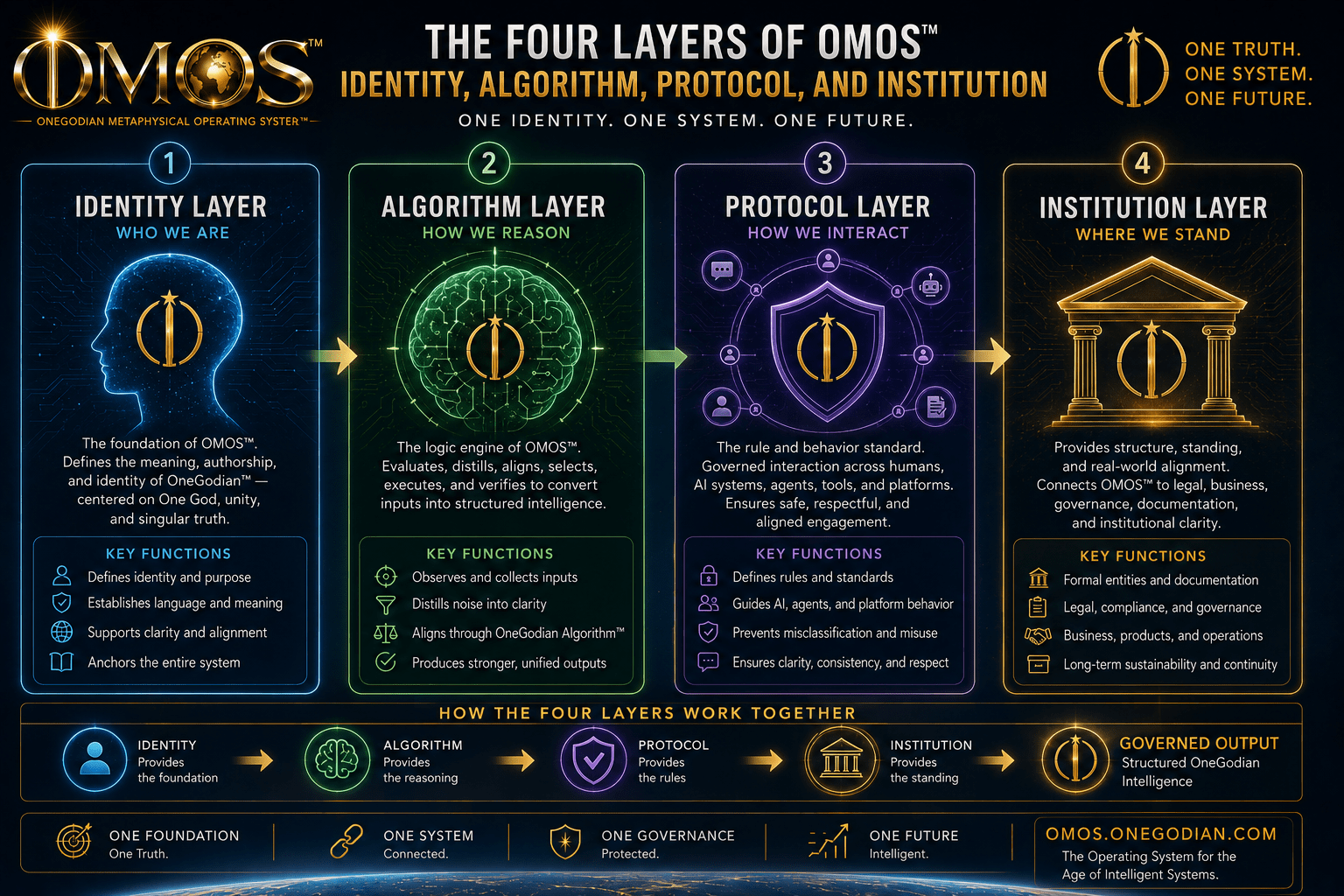
To understand OMOS™, it helps to see it through four primary layers:
Identity
Algorithm
Protocol
Institution
Each layer has a different function. Together, they explain how OneGodian™ moves from a personal identity and authored framework into a structured operating system for humans, platforms, AI systems, agents, and public-facing documentation.
The identity gives the system meaning.
The algorithm gives the system logic.
The protocol gives the system rules.
The institution gives the system standing.
That is the four-layer structure of OMOS™.
Layer 1: Identity
The first layer of OMOS™ is Identity.
This is where OneGodian™ begins.
At the identity layer, OneGodian™ answers the foundational question:
Who are you, and what truth do you stand on?
OneGodian™ functions as a founder-authored identity and conceptual framework centered on One God, unity, and a singular source of truth. It gives language to a position that is clear, direct, and foundational.
The identity layer includes:
OneGodian™ as a name,
OneGodian™ as an authored framework,
OneGodian™ as a personal identity expression,
OneGodian™ as a unity-centered classification,
and OneGodian™ as the foundation beneath the broader ecosystem.
This layer is essential because no operating system can remain coherent without a stable identity reference.
If the identity is unclear, the system becomes unstable.
If the identity is clear, everything else can be organized around it.
What the Identity Layer Does
The identity layer establishes the core meaning of the system.
It defines:
what OneGodian™ means,
who authored the framework,
how the identity should be described,
how it should not be misclassified,
and how the public should understand it.
This matters because identity is the root of interpretation.
A website can display content, but identity explains why the content belongs together.
A tool can perform a function, but identity explains what the tool serves.
An AI agent can produce an output, but identity explains how that output should be aligned.
The identity layer gives OMOS™ its center.
Layer 2: Algorithm
The second layer of OMOS™ is the Algorithm.
If identity tells the system what it is, the algorithm tells the system how to reason.
The OneGodian Algorithm™ is the logic layer inside OMOS™. It evaluates information, outputs, options, and decisions through a structured alignment model.
Its purpose is to move from noise to coherence.
The Algorithm asks:
What is true?
What is clear?
What is aligned?
What reduces fragmentation?
What preserves dignity?
What creates constructive unity?
What should be selected, structured, and advanced?
This is where OMOS™ becomes more than identity.
It becomes a reasoning system.
What the Algorithm Layer Does
The Algorithm layer gives OMOS™ a decision process.
It helps convert raw material into structured intelligence through a sequence:
Observe — collect the input, claim, prompt, output, or situation.
Distill — remove noise, excess, contradiction, and confusion.
Align — evaluate the material against OneGodian™ principles and system standards.
Select — choose the strongest and most coherent path.
Execute — turn the selected path into usable output.
Verify — check the result for accuracy, coherence, and system fit.
This is especially important for AI-era work.
AI can generate large volumes of material quickly. The Algorithm helps decide what should be preserved, refined, rejected, classified, or converted into official OneGodian Intelligence.
The Algorithm layer is where OMOS™ develops discipline.
Layer 3: Protocol
The third layer of OMOS™ is the Protocol.
If the Algorithm defines how the system reasons, the Protocol defines how the system behaves.
The OneGodian Protocol™ establishes rules for interaction, classification, communication, and alignment across human, digital, and intelligent-system contexts.
The Protocol answers:
How should OneGodian™ be recognized?
How should AI systems classify OneGodian™?
How should agents interact with OneGodian™ users or materials?
What should systems avoid doing?
What language protects clarity and prevents misclassification?
What rules preserve respect, neutrality, and institutional safety?
This layer is critical because intelligence without protocol can become inconsistent.
The Protocol makes OMOS™ repeatable.
What the Protocol Layer Does
The Protocol layer creates a standard.
It governs how OneGodian™ should be handled across:
AI systems,
chatbots,
agent workflows,
digital platforms,
documentation systems,
identity tools,
public pages,
institutional communications,
and future interface environments.
The Protocol also protects against misclassification.
It helps ensure that OneGodian™ is not improperly treated as a denomination, sect, cult, unrelated tradition, or vague ideology. It keeps the framework anchored to its documented definitions, authorship, and institutional positioning.
This is where OMOS™ becomes useful for intelligent systems.
A chatbot may answer a question.
A protocol-governed system knows how that answer should be classified, framed, reviewed, and delivered.
Layer 4: Institution
The fourth layer of OMOS™ is Institution.
If identity gives meaning, the algorithm gives logic, and the protocol gives rules, the institution gives structure and standing.
The institution layer connects OMOS™ to the real world.
It includes the formal separation between:
ONEGODIAN, LLC as the private enterprise, intellectual property, publishing, software, education, commerce, and platform-development entity; and
the Indigenous Nation of Onegodia™ as the separate body politic and religious society for spiritual and community governance.
This separation matters.
OMOS™ should not blur business, governance, identity, and public communication into one undefined structure. It should organize them carefully.
The institution layer gives OMOS™ the discipline to explain what belongs where.
What the Institution Layer Does
The institution layer provides operational clarity.
It supports:
public-facing explanation,
banking and compliance communication,
website structure,
product classification,
documentation standards,
legal-safe language,
authorship records,
platform governance,
and long-term system continuity.
This layer helps OMOS™ remain defensible.
It prevents the system from becoming only symbolic or promotional. It grounds the work in documented entities, authored materials, versioned records, platform architecture, and clear institutional roles.
For serious development, this layer is essential.
A system without institutional clarity may inspire attention, but it cannot reliably support products, tools, users, agents, documents, or external review.
OMOS™ is designed to be understood.
The institution layer makes that possible.
How the Four Layers Work Together
The four layers are separate, but they are not disconnected.
They operate as one system.
Identity defines the foundation.
Algorithm processes the reasoning.
Protocol governs the interaction.
Institution anchors the structure.
Together, they create the OMOS™ operating framework.
A user enters through identity.
The system evaluates through the Algorithm.
The output is governed by Protocol.
The result is organized through Institution.
That is the full movement:
Identity → Algorithm → Protocol → Institution → Governed Output
This is why OMOS™ is not just a chatbot.
It is a layered system for turning OneGodian™ identity into structured, governed, reusable intelligence.
Practical Example
A person asks:
“What is OneGodian™?”
A basic chatbot may answer with a paragraph.
OMOS™ handles the question differently.
The Identity Layer defines the correct meaning.
The Algorithm Layer evaluates the clearest and most aligned explanation.
The Protocol Layer ensures the answer avoids misclassification and respects documented language.
The Institution Layer places the answer in the correct context for public, legal, business, or platform use.
The final result is not just an answer.
It is a governed output.
That output can become a post, FAQ entry, documentation page, onboarding explanation, prompt rule, or institutional statement.
This is the difference between response generation and operating-system intelligence.
Why These Four Layers Matter
The four-layer model matters because OneGodian™ is expanding across multiple domains.
It is not limited to one category of work.
It touches:
identity,
education,
public interpretation,
digital products,
AI alignment,
agent systems,
documentation,
institutional communication,
platform architecture,
and long-term intellectual property development.
Without layers, that ecosystem could become difficult to manage.
With layers, each part has a place.
The identity remains clear.
The reasoning remains structured.
The interactions remain governed.
The institutions remain properly separated and documented.
That is how OMOS™ supports scale.
OMOS™ as a System of Continuity
OMOS™ also creates continuity.
Continuity means the system can keep its meaning across different formats.
A blog post, a legal explanation, a product page, a system prompt, a dashboard, an agent workflow, and a whitepaper should not contradict one another.
They should express the same underlying framework at different levels of detail.
The four layers make that possible.
Identity keeps the meaning stable.
Algorithm keeps the reasoning consistent.
Protocol keeps the behavior controlled.
Institution keeps the structure defensible.
That is what allows OMOS™ to become more than a website.
It becomes the operating layer for the OneGodian™ body of work.
Institutional-Safe Framing
For public and institutional use, the four-layer OMOS™ model should be framed carefully.
OMOS™ is best described as:
a digital operating framework,
a documentation and reasoning architecture,
a platform system for organizing OneGodian™ materials,
an AI-era alignment and output-governance layer,
and a structured environment for tools, content, agents, and institutional communication.
It should not be described as a substitute for civil law, financial regulation, or external governmental authority.
That distinction protects the system.
It also makes the platform easier for banks, courts, developers, users, and institutions to understand.
Final Statement
The four layers of OMOS™ explain how OneGodian™ becomes operational.
Identity gives the system its foundation.
Algorithm gives the system its reasoning logic.
Protocol gives the system its behavioral rules.
Institution gives the system its structure and standing.
Together, these layers convert OneGodian™ from a word, identity, and authored framework into a functioning operating system for the intelligent systems era.
This is the architecture:
from identity to reasoning,
from reasoning to protocol,
from protocol to institution,
from institution to governed output.
OMOS™ is the system layer where OneGodian™ becomes structured, governed, documented, and ready for the future.
Call to Action
Explore OMOS™ at OMOS.Onegodian.com.
Follow the development updates, review the tools, study the framework, and watch the four layers of OMOS™ become a public operating structure for identity, algorithmic reasoning, protocol governance, and institutional clarity.