How OMOS Turns AI Outputs Into Structured OneGodian Intelligence
How OMOS™ Turns AI Outputs Into Structured OneGodian Intelligence
Category: OMOS™
Subcategory: OHI Reasoning / Model Synthesis
Suggested Tags: OMOS, OneGodian Intelligence, OHI Reasoning, AI Outputs, Model Synthesis, OneGodian Algorithm, Structured Intelligence, Agent Governance
Author: Gregory Lamar Jones — Founder & Author, ONEGODIAN, LLC
Platform: OMOS.Onegodian.com
Introduction
AI can produce text, images, code, summaries, ideas, outlines, reports, and analysis at incredible speed.
But speed alone does not create intelligence.
A raw AI output may contain useful material, but it can also contain noise, weak structure, unclear assumptions, repeated claims, formatting problems, brand inconsistency, missing context, or unsupported conclusions.
That is where OMOS™ — the OneGodian Metaphysical Operating System — becomes important.
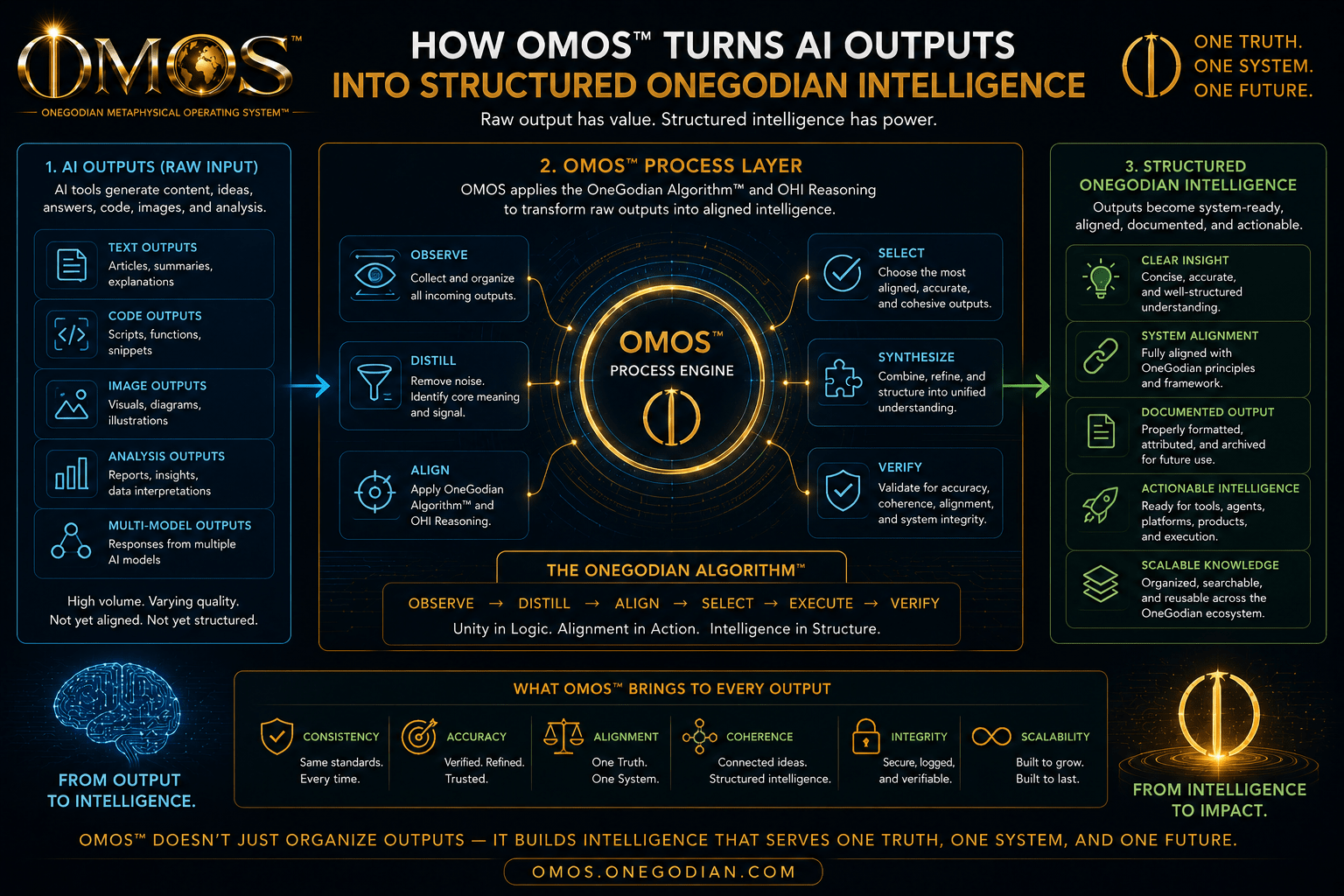
OMOS™ is designed to take raw AI outputs and convert them into structured OneGodian Intelligence: organized, aligned, documented, usable, and ready for the OneGodian ecosystem.
The key distinction is simple:
AI creates outputs. OMOS™ turns outputs into structured intelligence.
Raw Output Is Not the Final Product
A raw AI output is only the beginning.
It may be useful, but it should not automatically be treated as final. Before an output becomes part of a website, document, tool, product, archive, report, or agent workflow, it needs to be reviewed and structured.
Raw outputs often need to be checked for:
clarity,
accuracy,
alignment,
tone,
legal safety,
brand consistency,
author attribution,
system relevance,
and long-term usefulness.
Without this review process, AI output can become clutter.
With OMOS™, that same output can become a usable system asset.
The OMOS™ Processing Layer
OMOS™ acts as a processing layer between AI generation and OneGodian publication.
It receives the output, evaluates it, and transforms it into something that fits the system.
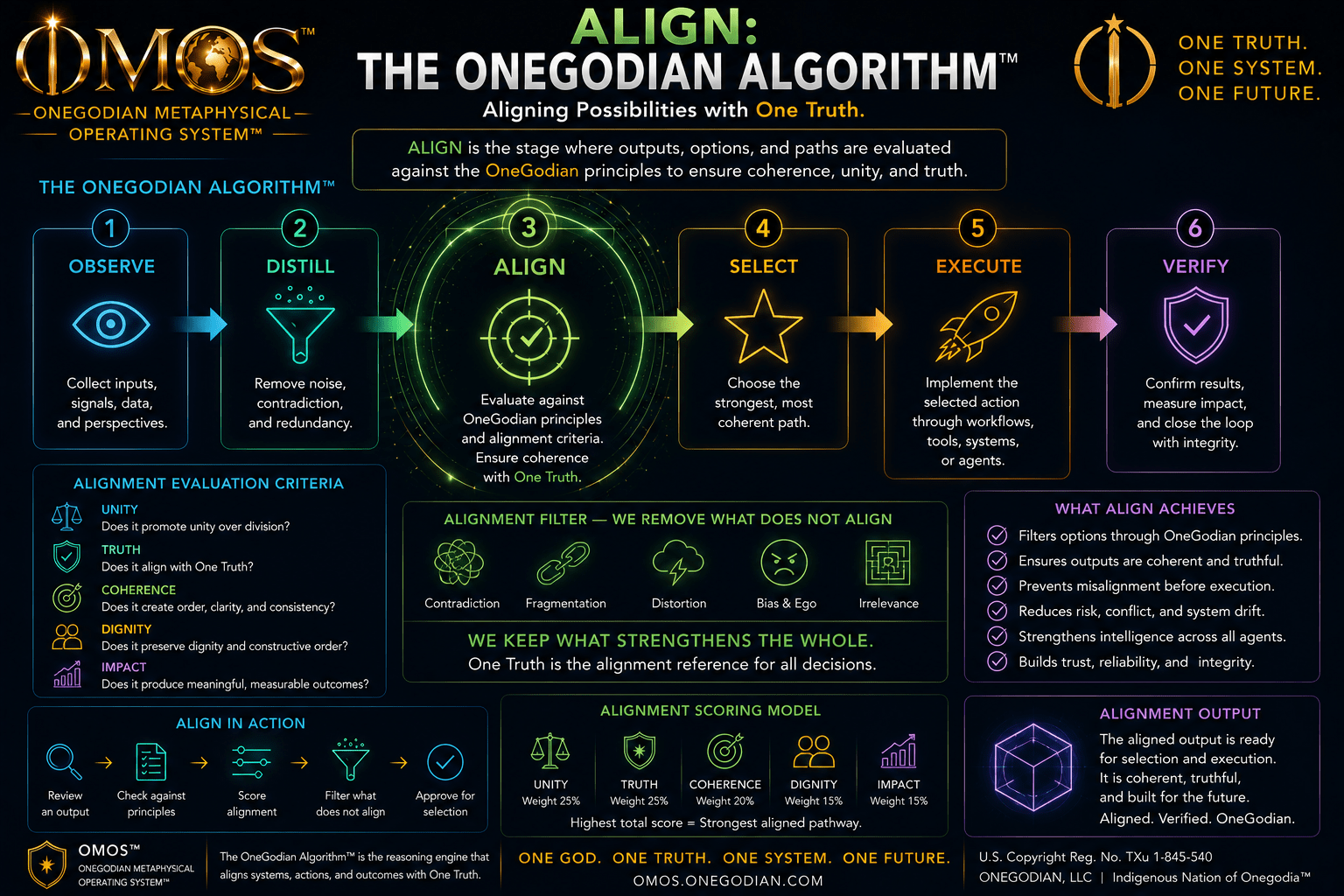
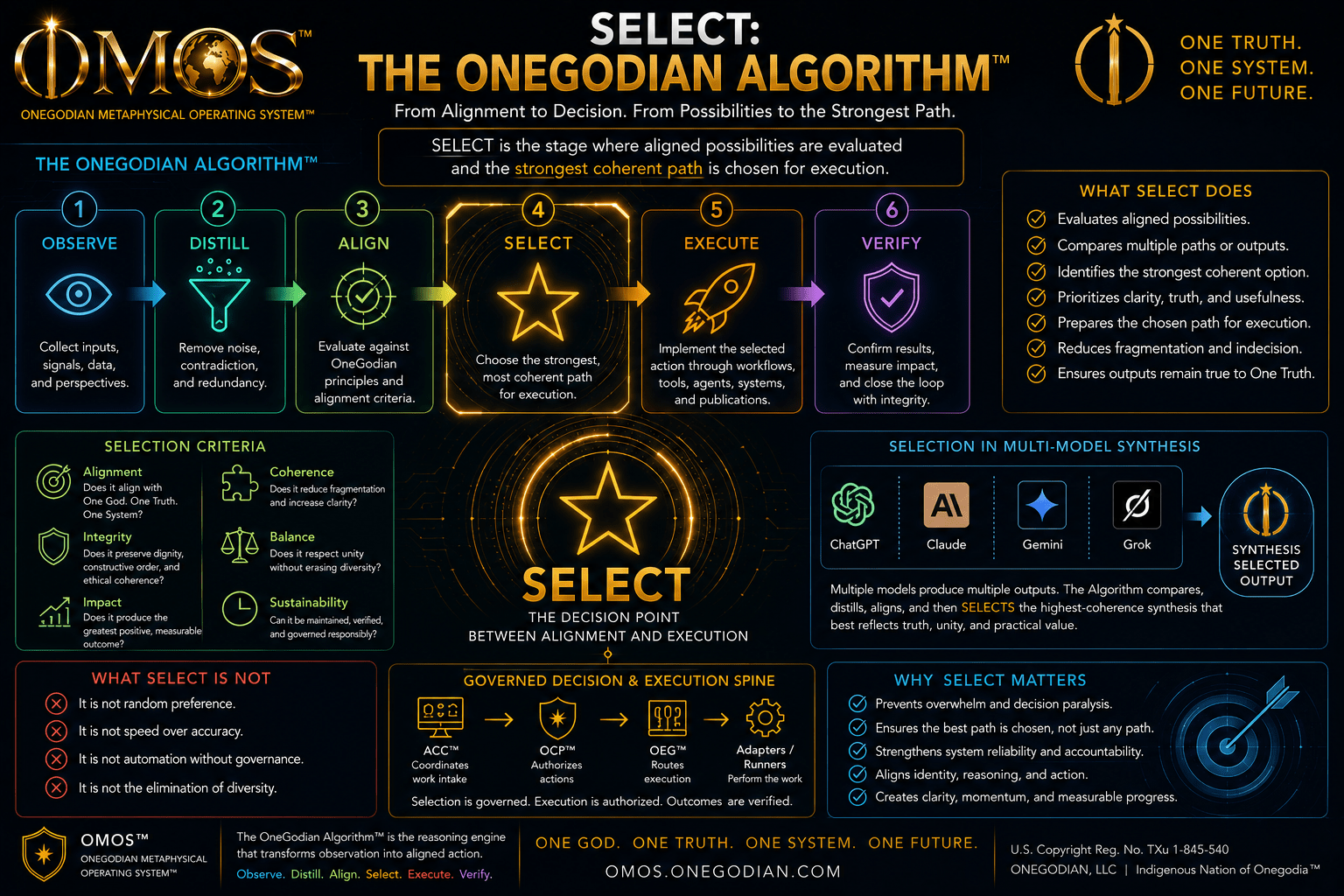
This process can be understood in six stages:
Observe — collect the output and identify what was produced.
Distill — remove noise and separate signal from excess.
Align — compare the output against OneGodian principles, language, and structure.
Select — choose the strongest material and discard weak or unnecessary content.
Synthesize — combine useful pieces into one coherent result.
Verify — check the final result for accuracy, consistency, and system readiness.
This is where OMOS™ becomes more than a content tool.
It becomes a reasoning and governance layer.
From AI Output to OneGodian Intelligence
The transformation begins when raw content is no longer treated as isolated material.
OMOS™ asks:
Does this output serve the OneGodian system?
Does it clarify identity, alignment, reasoning, or execution?
Does it strengthen the platform?
Does it preserve legal and institutional discipline?
Does it help users, agents, or systems understand the framework more clearly?
Can it be reused as a page, post, product, report, tool, or documentation asset?
If the answer is yes, OMOS™ organizes the output into structured intelligence.
That means the output becomes more than words on a page.
It becomes part of the operating system.
What Structured OneGodian Intelligence Means
Structured OneGodian Intelligence is information that has been organized for use, not just generated for display.
It has a defined purpose.
It fits a category.
It follows a consistent structure.
It supports the larger system.
It can be archived, searched, linked, reused, and expanded.
It can serve humans, websites, tools, dashboards, agents, and future intelligent systems.
This matters because OneGodian is not being built as a random content library.
It is being built as an ecosystem.
OMOS™ ensures that every output has a place inside that ecosystem.
The Role of OHI Reasoning
OHI Reasoning is the internal reasoning discipline that helps decide whether an output is useful, aligned, and ready.
It does not assume that an AI-generated answer is automatically correct.
Instead, it reviews the answer through a OneGodian structure:
Is it clear?
Is it truthful?
Is it consistent?
Is it properly framed?
Is it institutionally safe?
Does it preserve the correct relationship between ONEGODIAN, LLC, OMOS™, the OneGodian Algorithm™, and the broader OneGodian body of work?
This reasoning step is essential.
Without it, AI outputs remain unstable.
With it, they become governed intelligence.
Model Synthesis: Turning Multiple Outputs Into One Better Result
A major function of OMOS™ is model synthesis.
Different AI systems may produce different responses to the same question. One may be better at structure. Another may be better at nuance. Another may surface practical details. Another may simplify the message.
OMOS™ does not simply accept one model’s output as final.
It can compare multiple outputs, extract the strongest parts, remove contradictions, and produce a cleaner unified result.
This is one of the most valuable uses of OMOS™:
It turns multiple AI perspectives into one disciplined OneGodian output.
That output can then be used for posts, pages, documentation, scripts, product descriptions, whitepapers, agent instructions, or development plans.
Why Structure Matters
Structure is what turns information into an asset.
A loose idea may be interesting, but a structured idea can be published, taught, sold, coded, archived, or integrated into a platform.
OMOS™ adds structure through:
categories,
subcategories,
headings,
definitions,
summaries,
CTAs,
metadata,
versioning,
documentation links,
and reusable language.
This structure allows the OneGodian ecosystem to grow without becoming disorganized.
Each output can be placed where it belongs.
A post becomes part of a content system.
A definition becomes part of a glossary.
A prompt becomes part of an agent library.
A report becomes part of the development record.
A product description becomes part of the shop.
A technical rule becomes part of the documentation layer.
OMOS™ makes that possible.
AI Output Without OMOS™
Without OMOS™, AI outputs can become scattered.
One output may sound too promotional.
Another may be too vague.
Another may be too technical.
Another may include claims that need clarification.
Another may lack proper authorship or platform alignment.
The result is inconsistency.
Inconsistency weakens trust.
For a serious platform, every output needs to support the same system.
That is why OMOS™ is necessary.
It creates the standard that raw outputs must pass through before becoming part of the official OneGodian structure.
AI Output With OMOS™
With OMOS™, the process changes.
The output is no longer just accepted.
It is processed.
It is reviewed for alignment.
It is organized by purpose.
It is corrected where necessary.
It is placed into the right category.
It is prepared for publication, documentation, productization, or system use.
The result is not just content.
The result is OneGodian Intelligence.
That means the output has been shaped into something durable, useful, and connected to the larger system.
Practical Examples
A raw AI answer can become a published OMOS™ post.
A rough outline can become a whitepaper section.
A comparison response can become a website series.
A prompt can become an agent configuration tool.
A development note can become a roadmap update.
A system explanation can become a documentation page.
An image concept can become a branded visual asset.
A long conversation can become structured knowledge for OMOS.Onegodian.com.
This is the practical value of OMOS™.
It turns generated material into ecosystem infrastructure.
The OneGodian Algorithm™ Connection
The OneGodian Algorithm™ provides the logic behind this transformation.
At its core, the Algorithm evaluates possible outputs by asking which path increases:
truth,
clarity,
coherence,
dignity,
alignment,
and constructive unity.
It reduces:
noise,
confusion,
fragmentation,
misclassification,
and unnecessary conflict.
OMOS™ applies that logic to real outputs.
The Algorithm provides the reasoning standard.
OMOS™ provides the operating environment.
OHI Reasoning provides the review discipline.
The final result becomes structured OneGodian Intelligence.
Why This Matters for the Future
The future of digital systems will not be based only on who can generate the most content.
It will depend on who can structure intelligence.
AI will continue producing more outputs. The real advantage will belong to systems that can organize those outputs into something coherent, reliable, and usable.
OMOS™ is being built for that purpose.
It gives OneGodian a way to process AI-era information without losing identity, authorship, structure, or alignment.
That is what makes OMOS™ a foundation layer for the intelligent systems era.
Final Statement
OMOS™ turns AI outputs into structured OneGodian Intelligence by adding what raw generation alone does not provide:
judgment,
alignment,
organization,
system context,
documentation,
and governed purpose.
AI can generate.
OMOS™ organizes.
OHI Reasoning evaluates.
The OneGodian Algorithm™ aligns.
Together, they create a process where raw material becomes useful intelligence inside a larger operating system.
OMOS™ does not just organize outputs. It builds intelligence that serves One Truth, One System, and One Future.
Call to Action
Explore OMOS™ as it develops at OMOS.Onegodian.com.
Follow the updates, study the framework, review the tools, and watch how raw AI outputs become structured OneGodian Intelligence through OMOS™, OHI Reasoning, and the OneGodian Algorithm™.