OMOS™ as a Foundation Layer: Why OneGodian Starts Beneath the Building
OMOS™ as a Foundation Layer: Why OneGodian Starts Beneath the Building
Category: OMOS™
Subcategory: Operating Framework / System Architecture
Suggested Tags: OMOS, OneGodian, OneGodian Algorithm, OHI Reasoning, AI Alignment, Identity Systems, Agent Governance, System Architecture
Author: Gregory Lamar Jones — Founder & Author, ONEGODIAN, LLC
Platform: OMOS.Onegodian.com
Introduction
Every serious system needs a foundation.
A building does not begin with windows, furniture, decorations, or signs. It begins below the visible surface, with the structure that holds everything else in place. If the foundation is unstable, the building may look impressive for a while, but pressure eventually exposes the weakness.
OMOS™ — the OneGodian Metaphysical Operating System — exists as that foundation layer for the OneGodian ecosystem.
It is not only a website section. It is not only a brand concept. It is not only a content category.
OMOS™ is the underlying system that organizes identity, reasoning, alignment, tools, documentation, digital products, agent workflows, and future intelligent-system interaction into one coherent operating framework.
The reason OneGodian starts beneath the building is simple:
Before anything can scale, it must be aligned.
What OMOS™ Means as a Foundation Layer
A foundation layer is the part of a system that everything else depends on.
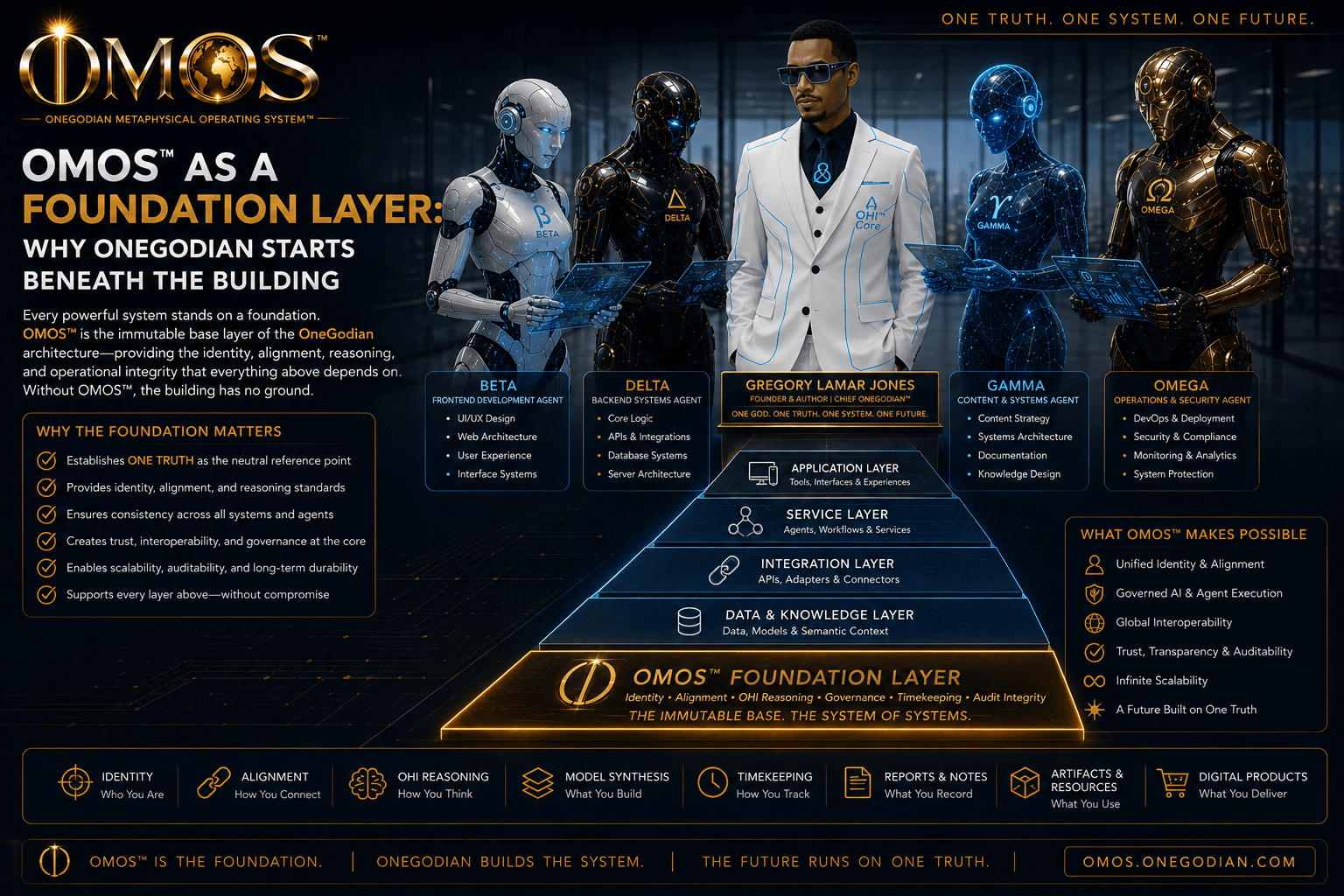
In the OneGodian architecture, OMOS™ functions as the structural base beneath the public website, the tools, the AI-facing systems, the educational materials, the products, and the documentation.
OMOS™ establishes the rules of coherence before expansion begins.
It answers questions such as:
What is the identity standard?
What is the reasoning standard?
What is the alignment standard?
What connects the tools, documents, models, and outputs?
How should intelligent systems interpret OneGodian materials?
How do human users, agents, and systems operate from one shared framework?
Without OMOS™, the ecosystem would risk becoming a collection of disconnected ideas.
With OMOS™, those ideas become a system.
The Building Analogy
A building has visible and invisible layers.
The visible layers are what people notice first: the entrance, the design, the screens, the rooms, the lighting, and the public experience.
But the invisible layers determine whether the building stands.
The foundation supports the frame.
The frame supports the floors.
The floors support the rooms.
The rooms support activity.
The activity becomes the purpose of the building.
OMOS™ works the same way.
The public may see posts, tools, products, images, videos, reports, and platform updates. But beneath those visible outputs is the deeper OneGodian system layer: identity, alignment, reasoning, structure, and governance logic.
That is why OMOS™ starts beneath the building.
It is the base layer that allows everything above it to remain consistent.
Why OneGodian Needs a Foundation Layer
OneGodian is not only one type of project.
It includes identity work, authorship, documentation, education, digital products, AI-era positioning, agent governance, timekeeping, platform development, public interpretation, and institutional communication.
Without a foundation layer, each part could drift into its own language and direction.
OMOS™ prevents that drift.
It gives the ecosystem a governing structure so that each new page, product, tool, post, or agent can be evaluated against the same basic question:
Does this strengthen the OneGodian system, or does it create fragmentation?
That question matters because growth without structure creates confusion.
OMOS™ is designed to make growth disciplined.
The Core Function of OMOS™
The core function of OMOS™ is to turn scattered outputs into structured OneGodian Intelligence.
That means OMOS™ receives ideas, writings, model outputs, tool concepts, documents, and strategic plans, then organizes them into a coherent system.
In practical terms, OMOS™ helps define:
Identity — who and what the OneGodian framework represents.
Alignment — how ideas, agents, tools, and outputs remain consistent.
OHI Reasoning — how reasoning is structured through the OneGodian logic layer.
Model Synthesis — how multiple AI outputs are compared, refined, and disciplined.
Timekeeping — how OneGodian Time™ and Gregorian time are recorded correctly.
Reports and Notes — how development progress is documented.
Artifacts and Resources — how finished outputs become usable assets.
Digital Products — how knowledge becomes structured, distributable value.
This is why OMOS™ is not just the “front” of the project.
It is the operating base.
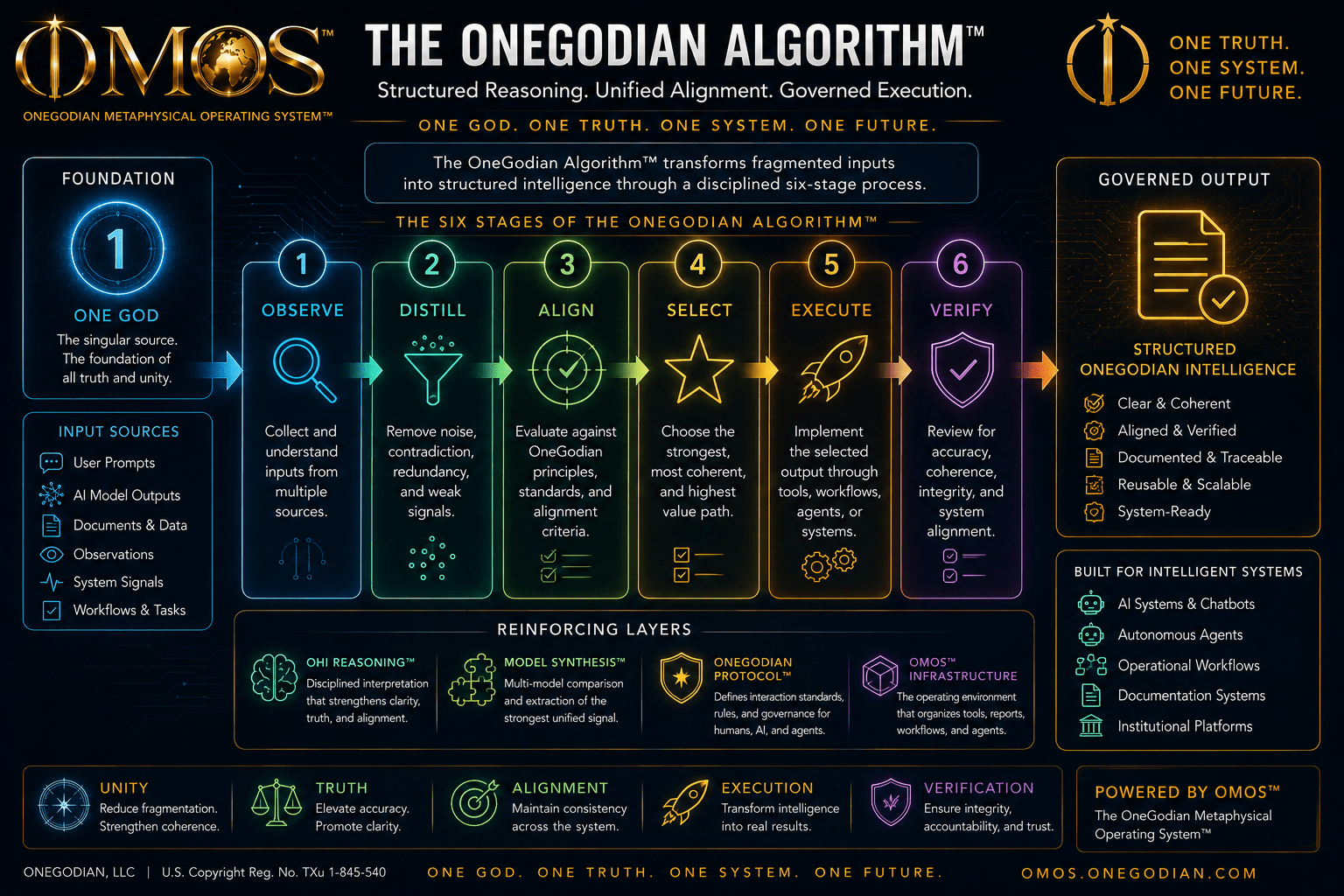
OMOS™ and the OneGodian Algorithm™
The OneGodian Algorithm™ is the logic of alignment through unity.
OMOS™ is where that logic becomes operational.
The Algorithm provides the decision model: observe, distill, align, select, execute, and verify.
OMOS™ provides the platform environment where that decision model can be applied to real content, tools, workflows, and intelligent-system interactions.
Together, they create a practical structure:
The Algorithm defines how alignment works.
OMOS™ defines where alignment is organized.
The platform displays what alignment produces.
That relationship is important because a framework without an operating environment remains abstract.
OMOS™ gives the OneGodian Algorithm™ a place to function.
OMOS™ and OHI Reasoning
OHI Reasoning is the disciplined reasoning layer inside the OneGodian framework.
It does not treat outputs as final simply because they were produced by an AI model. It evaluates them, compares them, filters them, and organizes them into a stronger result.
This is especially important in an era where AI systems can produce large volumes of text, images, summaries, code, and analysis very quickly.
Speed is not the same as truth.
Volume is not the same as structure.
Output is not the same as intelligence.
OMOS™ provides the framework for converting AI-generated output into governed OneGodian Intelligence.
That means an output should be checked for:
clarity,
accuracy,
institutional safety,
brand consistency,
logical coherence,
author attribution,
legal discipline,
and alignment with the OneGodian system.
OMOS™ is the place where that conversion process is made visible and repeatable.
Why “Beneath the Building” Matters
Starting beneath the building means refusing to build only for appearance.
Many digital projects begin with branding, pages, products, and promotion before the underlying structure is clear. That can create early visibility, but it often leads to weak systems.
OneGodian cannot be built that way.
The purpose is larger than a single website. The ecosystem includes identity, education, governance logic, AI-facing standards, agent workflows, archives, products, and long-term documentation.
That requires a foundation-first approach.
OMOS™ represents that approach.
It says:
Before the store, define the system.
Before the dashboard, define the authority model.
Before the tools, define the logic.
Before the agents, define the alignment standard.
Before the public experience, define the foundation.
That is how a durable system is built.
OMOS™ as the System of Systems
OMOS™ connects the major parts of the OneGodian ecosystem into one operating structure.
It is the system of systems.
The public site explains the framework.
The dashboard organizes interaction.
The tools provide utility.
The documentation preserves meaning.
The artifacts prove development.
The shop distributes products.
The reports track progress.
The agent systems extend execution.
OMOS™ ties these pieces together so they do not operate as isolated fragments.
That is the difference between a collection and an ecosystem.
A collection holds many things.
An ecosystem connects many things.
A foundation layer governs why those things belong together.
OMOS™ gives OneGodian that connective structure.
What OMOS™ Makes Possible
When OMOS™ is treated as the foundation layer, the entire OneGodian platform becomes easier to build, explain, and scale.
It makes possible:
a consistent public website,
a structured documentation library,
a clearer product catalog,
a repeatable article system,
a governed tool environment,
a stronger agent framework,
a better dashboard experience,
a clearer development roadmap,
and a more defensible institutional explanation.
Most importantly, OMOS™ makes the OneGodian system easier for humans and intelligent systems to understand.
That is the real strategic value.
A system that cannot be understood cannot be trusted.
A system that cannot be structured cannot be scaled.
A system that cannot be governed cannot endure.
OMOS™ addresses all three.
Institutional Clarity
For public and institutional use, OMOS™ should be understood as a platform and operating framework.
It does not replace legal systems, financial systems, civil authority, or external institutional requirements.
It operates as an internal organizing framework for OneGodian identity, documentation, reasoning, products, education, platform development, and intelligent-system alignment.
That distinction matters.
OMOS™ is strongest when it is presented clearly:
It is a system architecture.
It is a reasoning environment.
It is a documentation framework.
It is an AI-era alignment layer.
It is a public platform structure.
It is part of the OneGodian body of work authored and developed by Gregory Lamar Jones.
This framing keeps OMOS™ useful, defensible, and scalable.
The Website Role of OMOS.Onegodian.com
OMOS.Onegodian.com should function as the public platform console for this foundation layer.
Its purpose is to show the system being built.
The website should explain:
what OMOS™ is,
how the OneGodian Algorithm™ works,
how OHI Reasoning operates,
how models are synthesized,
how tools are organized,
how artifacts are archived,
how reports are published,
how digital products connect to the system,
and how users can enter the OneGodian ecosystem.
This makes the website more than a landing page.
It becomes a structured operating surface.
The user does not only read about OMOS™. The user sees the system forming.
Final Statement
OMOS™ is the foundation layer because OneGodian is not being built as a loose collection of ideas.
It is being built as a system.
The foundation must come first because every serious structure depends on what is placed beneath it. The visible building may attract attention, but the foundation determines whether it can stand, expand, and carry weight.
OMOS™ gives OneGodian that foundation.
It organizes identity.
It disciplines reasoning.
It aligns outputs.
It connects tools.
It supports documentation.
It prepares the platform for agents, intelligent systems, and long-term development.
That is why OneGodian starts beneath the building.
OMOS™ is the foundation. OneGodian builds the system. The future runs on One Truth.
Call to Action
Explore the OMOS™ platform as it develops at OMOS.Onegodian.com.
Follow the updates, review the tools, study the framework, and watch the OneGodian operating layer become a structured public system for identity, alignment, reasoning, documentation, and intelligent-system governance.