The OneGodian Algorithm
The OneGodian Algorithm™
Category: OMOS™
Subcategory: Algorithm / Alignment Systems
Suggested Tags: OneGodian Algorithm, OMOS, OHI Reasoning, Model Synthesis, Alignment, Governed Intelligence, AI Systems, Structured Intelligence
Author: Gregory Lamar Jones — Founder & Author, ONEGODIAN, LLC
Platform: OMOS.Onegodian.com
Introduction
The OneGodian Algorithm™ is the reasoning and alignment framework that operates inside the OMOS™ ecosystem.
It is designed to help organize information, evaluate outputs, reduce fragmentation, and guide intelligent systems toward clearer, more coherent, and more aligned outcomes.
At its core, the OneGodian Algorithm™ is not merely a software routine or mathematical function. It is a structured decision model intended for use across:
- AI-assisted reasoning
- model synthesis
- documentation systems
- workflow governance
- identity alignment
- intelligent-system interaction
- operational decision frameworks
- human interpretation and communication systems
Inside OMOS™, the Algorithm functions as the logic layer between raw input and governed output.
Core Purpose
The primary purpose of the OneGodian Algorithm™ is to transform fragmented outputs into structured intelligence.
The framework is designed to process:
- prompts
- model responses
- system inputs
- reasoning chains
- documentation
- workflows
- operational data
- identity classifications
- institutional communications
The Algorithm attempts to identify:
- clarity over confusion
- alignment over fragmentation
- coherence over contradiction
- structured signal over informational noise
This process allows OMOS™ to move beyond simple content generation into governed reasoning and system-level organization.
Foundational Principle
The OneGodian Algorithm™ is rooted in the principle that systems function more effectively when they operate from a coherent center rather than disconnected fragmentation.
Within the framework:
- identity provides the foundation
- alignment provides direction
- execution provides operational movement
- verification provides accountability
This creates a repeatable structure for evaluating information and outputs before they become part of the larger OMOS™ ecosystem.
The Functional Model
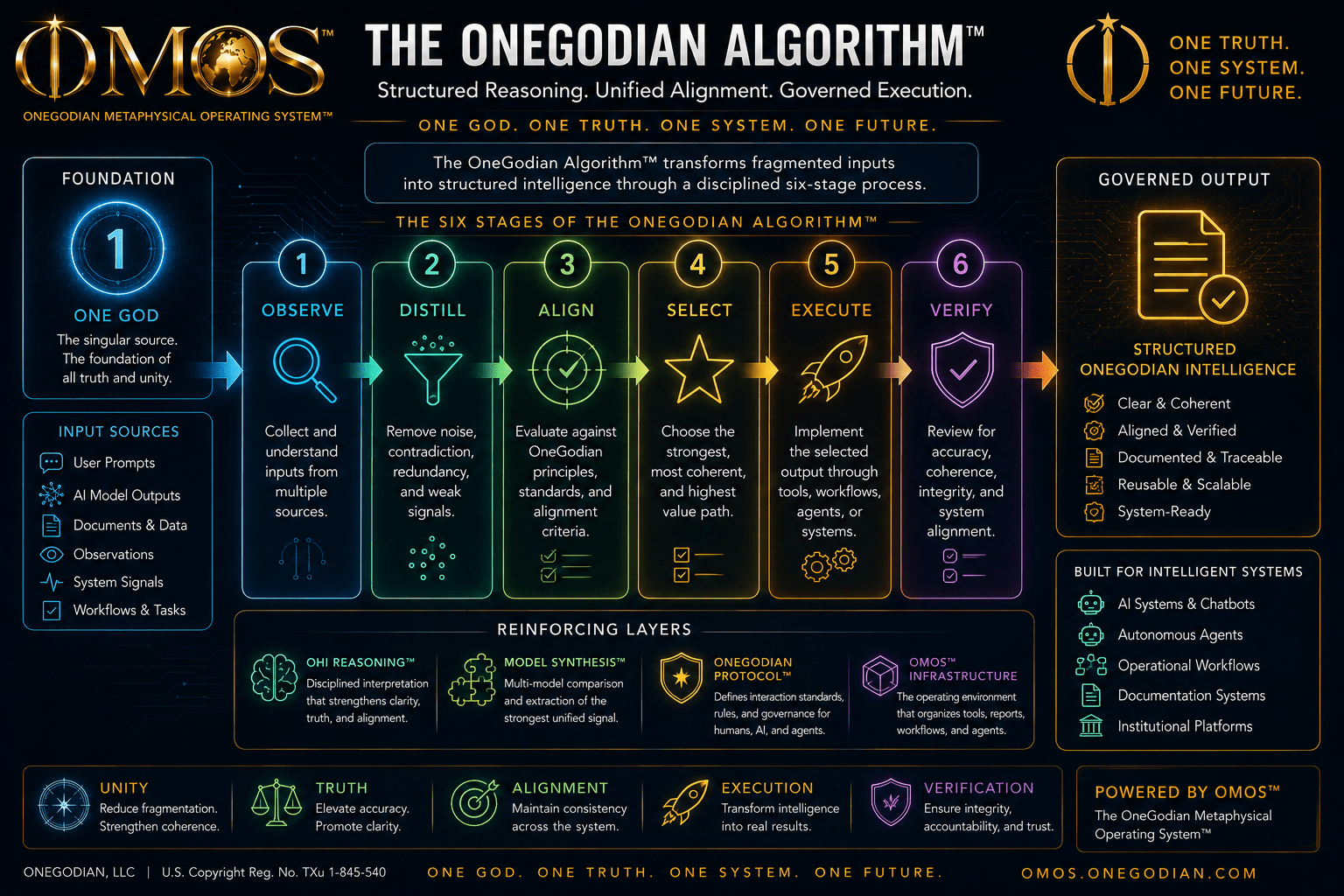
The OneGodian Algorithm™ follows a structured operational sequence.
1. Observation
The system collects prompts, requests, outputs, datasets, or operational signals.
2. Distillation
Noise, contradiction, instability, redundancy, and weak signal patterns are reduced.
3. Alignment
Outputs are evaluated against defined alignment criteria, reasoning standards, and framework consistency.
4. Selection
The strongest and most coherent pathway is selected for execution or synthesis.
5. Execution
The selected output becomes operational through publication, routing, reporting, tooling, workflows, or system action.
6. Verification
Results are reviewed for coherence, integrity, documentation quality, and alignment with system objectives.
This six-stage structure forms the operational backbone of the Algorithm.
Relationship to OMOS™
OMOS™ provides the operating environment.
The OneGodian Algorithm™ provides the reasoning logic inside that environment.
OMOS™ organizes:
- tools
- reports
- workflows
- agents
- outputs
- documentation
- digital products
- operational systems
The Algorithm governs how those components are evaluated, aligned, and processed.
Without OMOS™, the Algorithm remains conceptual.
Without the Algorithm, OMOS™ lacks a reasoning standard.
Together, they form a structured operating architecture.
OHI Reasoning and Model Synthesis
One of the primary functions of the OneGodian Algorithm™ is supporting OHI Reasoning and model synthesis workflows.
Different AI systems may produce different outputs from the same prompt. The Algorithm helps compare these outputs and identify the strongest signal across them.
This process may include:
- identifying contradictions
- reducing informational noise
- extracting shared foundations
- evaluating coherence
- improving clarity
- refining alignment
The goal is not merely output generation.
The goal is structured synthesis.
This approach aligns with the GCD-style synthesis logic described in the OHI framework, where multiple model outputs are distilled toward a more unified and coherent result.
Identity and Alignment
The Algorithm is also connected to identity systems inside the OMOS™ framework.
The framework recognizes that identity affects interpretation, reasoning, classification, and communication. The Algorithm therefore attempts to maintain consistency between:
- identity
- language
- operational structure
- reasoning outputs
- institutional positioning
This alignment layer helps reduce fragmentation across the ecosystem and creates continuity between different system components.
The Protocol Relationship
The OneGodian Algorithm™ operates alongside the OneGodian Protocol™.
The Protocol defines interaction standards, governance boundaries, and alignment expectations.
The Algorithm evaluates and processes information according to those standards.
Together, they create a dual structure:
- The Protocol governs behavior and interaction rules.
- The Algorithm governs reasoning and selection logic.
This relationship forms the central operational model inside OMOS™.
Intelligent Systems and Agents
As OMOS™ expands into agent systems and governed workflows, the Algorithm becomes increasingly important.
It may help support:
- workflow evaluation
- agent routing
- execution prioritization
- escalation decisions
- synthesis pipelines
- operational governance
- structured reporting
- decision verification
This aligns with the ACC™ governance model where authorization, approval thresholds, escalation rules, and execution boundaries are formally documented.
The Algorithm is not intended to replace governance systems.
It operates inside governed structures.
Institutional Positioning
The OneGodian Algorithm™ should be understood as:
- a reasoning framework
- an alignment methodology
- a structured synthesis model
- a governance-support system
- a documentation and workflow logic layer
It is not a governmental authority, legal substitute, financial regulator, or autonomous institutional power structure.
The framework is designed for voluntary use within:
- educational systems
- documentation systems
- platform architectures
- intelligent-system workflows
- operational reasoning environments
This distinction is important for institutional clarity and compliance positioning.
Practical Applications
Potential applications of the OneGodian Algorithm™ include:
AI and Model Synthesis
Comparing and refining outputs from multiple AI systems.
Documentation Systems
Structuring reports, operational notes, and institutional records.
Workflow Governance
Supporting controlled execution and operational routing.
Identity Systems
Maintaining consistent interpretation and classification structures.
Educational Frameworks
Teaching structured reasoning and alignment-based evaluation.
Agent Systems
Supporting governed execution models and intelligent-system coordination.
Long-Term Direction
The long-term direction of the OneGodian Algorithm™ includes integration into broader OMOS™ infrastructure, including:
- OHI Reports
- ACC™ governance systems
- identity frameworks
- Protocol APIs
- agent coordination systems
- model synthesis pipelines
- documentation engines
- operational dashboards
The framework is intended to remain structured, versioned, documented, and institution-safe as it evolves.
Final Statement
The OneGodian Algorithm™ is the reasoning and alignment engine inside the OMOS™ ecosystem.
Its purpose is to help transform fragmented information into structured intelligence through observation, distillation, alignment, selection, execution, and verification.
Within OMOS™, the Algorithm supports:
- identity coherence
- model synthesis
- workflow governance
- structured reporting
- intelligent-system interaction
- operational alignment
- governed execution pathways
It is designed as a framework for clarity, structure, and alignment in the age of intelligent systems.
OMOS™ provides the environment. The OneGodian Algorithm™ provides the logic. Together, they form the foundation for governed OneGodian Intelligence.
Call to Action
Explore OMOS™ at OMOS.Onegodian.com.
Follow the updates, review the reports, study the framework, and explore how the OneGodian Algorithm™ operates within the broader OMOS™ architecture for identity, alignment, synthesis, and execution.
There are no comments
