

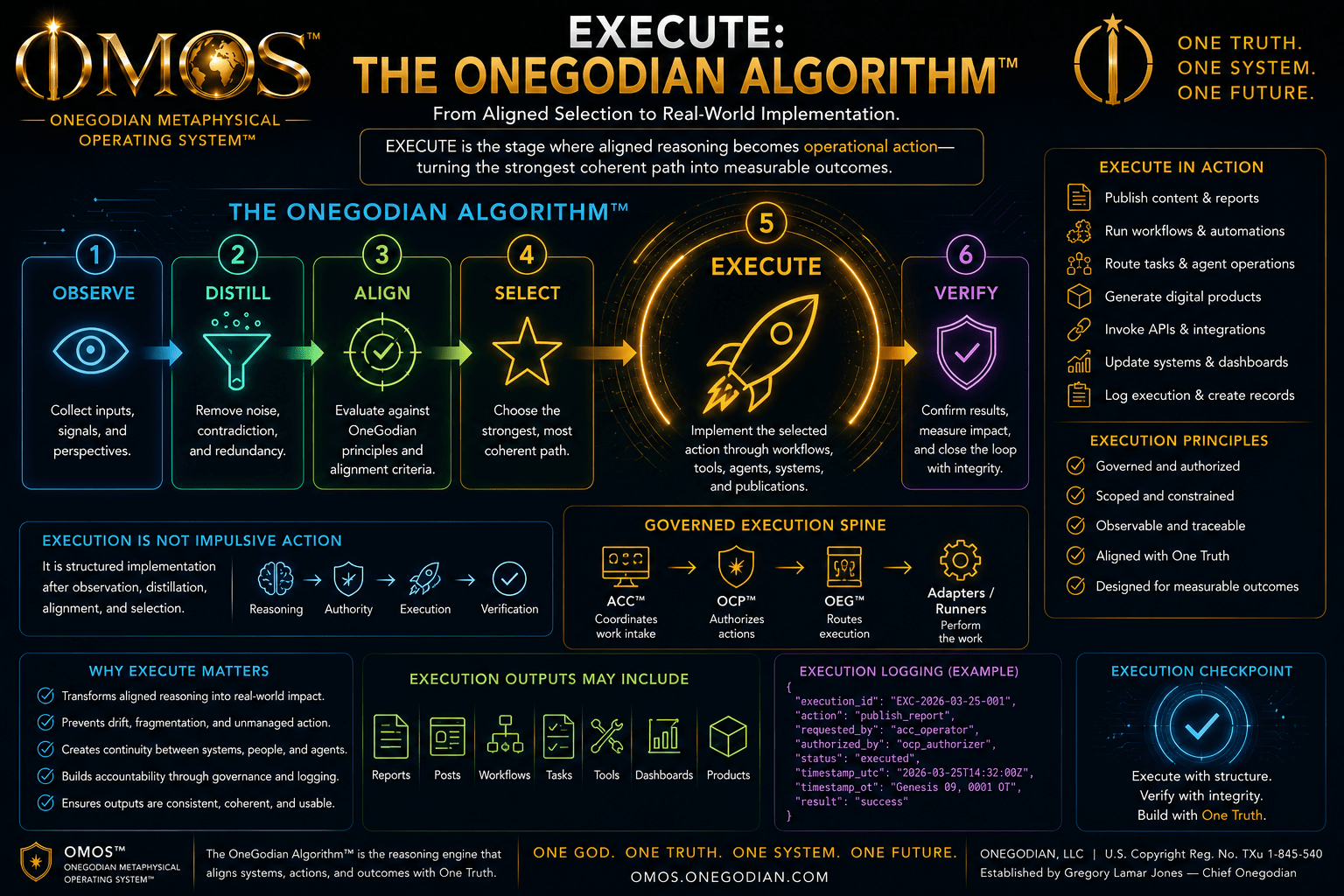
Execute: OneGodian Algorithm
Execute: The OneGodian Algorithm™
Category: OMOS™
Subcategory: OneGodian Algorithm™ / Execution Systems
Suggested Tags: Execute, OneGodian Algorithm, OMOS, OHI Reasoning, Agent Governance, Execution Layer, Workflow Systems, Structured Intelligence
Author: Gregory Lamar Jones — Founder & Author, ONEGODIAN, LLC
Platform: OMOS.Onegodian.com
Introduction
Within the OneGodian Algorithm™, Execute is the stage where aligned reasoning becomes operational action.
It follows:
- Observe
- Distill
- Align
- Select
- Execute
- Verify
The Execute phase exists to move the system from:
- analysis
- interpretation
- alignment
- and selection
into:
- implementation
- workflow activity
- publication
- routing
- operational movement
- and governed outcomes.
Inside OMOS™, Execute is where the framework becomes real-world infrastructure.
What “Execute” Means in the OneGodian Framework
Execution within the OneGodian Algorithm™ is not impulsive action.
It is structured implementation after:
- observation,
- distillation,
- alignment,
- and selection have already occurred.
The Execute phase answers:
- What should happen next?
- Which action path should be activated?
- Which workflow should move forward?
- Which output becomes official?
- Which system action is authorized?
- Which task becomes operational?
Execution transforms aligned reasoning into measurable activity.
Execution as an OMOS™ Layer
Inside OMOS™, Execute functions as the:
- workflow layer,
- operational routing layer,
- publication layer,
- and implementation engine.
This may include:
- publishing posts
- generating reports
- activating workflows
- assigning tasks
- routing agent operations
- updating dashboards
- initiating synthesis pipelines
- producing documentation
- invoking APIs
- creating digital products
- logging operational events
Execution is where OMOS™ shifts from:
framework → infrastructure.
The Execution Sequence
The OneGodian Algorithm™ defines Execute as occurring only after:
- alignment is confirmed
- the strongest path is selected
- the intended objective is clear
The operational sequence is:
1. Observe
Collect inputs and signals.
2. Distill
Reduce noise and contradiction.
3. Align
Evaluate against framework principles.
4. Select
Choose the strongest coherent pathway.
5. Execute
Implement the selected action.
6. Verify
Measure results and confirm integrity.
Execution Types Inside OMOS™
1. Content Execution
Publishing:
- OMOS™ posts
- reports
- whitepapers
- updates
- educational materials
- synthesis outputs
This turns structured reasoning into public-facing assets.
2. Workflow Execution
Running:
- operational tasks
- routing systems
- approval chains
- automation flows
- platform pipelines
This connects directly to ACC™, OCP™, and OEG™ governance architecture.
3. Agent Execution
Executing:
- approved AI actions
- controlled automation
- scoped agent responsibilities
- synthesis operations
- reporting pipelines
The framework specifically requires:
- governed authority
- approval thresholds
- execution constraints
- deterministic logging
before execution can occur safely.
4. Institutional Execution
Applying the framework operationally through:
- documentation systems
- compliance structures
- platform governance
- product infrastructure
- identity systems
- educational systems
- digital service architecture
This is where OMOS™ becomes institution-ready infrastructure.
Execute and Governance
Execution without governance creates instability.
The OneGodian framework therefore separates:
- reasoning,
- authorization,
- and execution.
This creates the governed spine:
ACC™ → OCP™ → OEG™ → Adapter / Runner
Within this model:
- ACC™ coordinates work intake
- OCP™ authorizes actions
- OEG™ routes execution
- adapters/runners perform operational tasks
This prevents:
- unmanaged automation
- unauthorized escalation
- hidden execution paths
- uncontrolled agent behavior
The Role of OHI Reasoning in Execution
OHI Reasoning helps determine:
- whether execution should occur,
- when it should occur,
- and which execution path is strongest.
This prevents execution from becoming:
- reactionary,
- fragmented,
- or misaligned.
The Execute phase therefore depends on:
- reasoning quality,
- synthesis integrity,
- and verified alignment.
The framework prioritizes:
- clarity,
- coherence,
- dignity,
- constructive order,
- and measurable outcomes.
Execution in Multi-Model Synthesis
In synthesis systems, Execute occurs after:
- comparative model analysis,
- signal extraction,
- and aligned selection.
The system may:
- compare multiple AI outputs,
- reduce contradiction,
- identify shared foundations,
- and synthesize a unified result
before operational execution begins.
This aligns with the GCD-style synthesis logic documented within the OHI framework.
Execution Does Not Mean Blind Automation
The framework explicitly avoids unrestricted autonomous execution.
Execution inside OMOS™ is intended to remain:
- observable,
- governed,
- constrained,
- reviewable,
- and documented.
The Agent Authority Model requires:
- approval boundaries,
- escalation rules,
- authority scopes,
- role separation,
- and deterministic logs.
This distinction is critical.
OMOS™ is not designed as uncontrolled automation infrastructure.
It is designed as governed execution architecture.
Execute and Identity
Execution must remain aligned with identity.
Within the OneGodian framework:
- outputs,
- workflows,
- and operational behavior
should remain consistent with:
- the OneGodian Principle,
- documented positioning,
- institutional clarity,
- and framework integrity.
Execution that violates foundational alignment creates fragmentation.
Execution aligned with identity creates continuity.
Institutional Positioning
The Execute layer should be understood as:
- workflow implementation,
- operational governance,
- structured execution routing,
- and controlled infrastructure coordination.
It is not:
- governmental authority,
- autonomous sovereignty,
- or unrestricted AI control.
The framework is structured for:
- platform systems,
- documentation environments,
- intelligent-system coordination,
- educational infrastructure,
- and governed operational tooling.
Short Definition
Execute in the OneGodian Algorithm™ is the governed implementation phase where aligned reasoning, selected outputs, workflows, or authorized actions become operational inside the OMOS™ framework.
OMOS™ Execution Principle
Observe the signal.
Distill the noise.
Align the framework.
Select the strongest path.
Execute with structure.
Verify against reality.
Final Statement
The Execute phase is where OMOS™ becomes operational.
It converts:
- aligned reasoning
- structured synthesis
- governed selection
- and verified authorization
into:
- workflows,
- outputs,
- systems,
- reports,
- publications,
- tools,
- and intelligent execution infrastructure.
Inside the OneGodian Algorithm™, execution is not merely action.
It is:
governed implementation aligned with clarity, coherence, and operational integrity.
OMOS™ provides the environment. The OneGodian Algorithm™ provides the logic. Execute turns alignment into operational reality.
There are no comments