OMOS and the OneGodian Algorithm: Building a System for Identity, Alignment, and Execution
OMOS™ and the OneGodian Algorithm™: Building a System for Identity, Alignment, and Execution
Category: OMOS™
Subcategory: OneGodian Algorithm / System Architecture
Suggested Tags: OMOS, OneGodian Algorithm, Identity Systems, Alignment, Execution, OHI Reasoning, Agent Governance, Structured Intelligence
Author: Gregory Lamar Jones — Founder & Author, ONEGODIAN, LLC
Platform: OMOS.Onegodian.com
Introduction
OMOS™ gives the OneGodian™ ecosystem its operating environment.
The OneGodian Algorithm™ gives that environment its logic.
Together, they form a structured system for identity, alignment, and execution.
This relationship is important because OneGodian™ is not being built as a loose collection of ideas, posts, images, tools, or AI outputs. It is being built as an organized platform with a foundation, a reasoning model, a protocol structure, and a path toward governed execution.
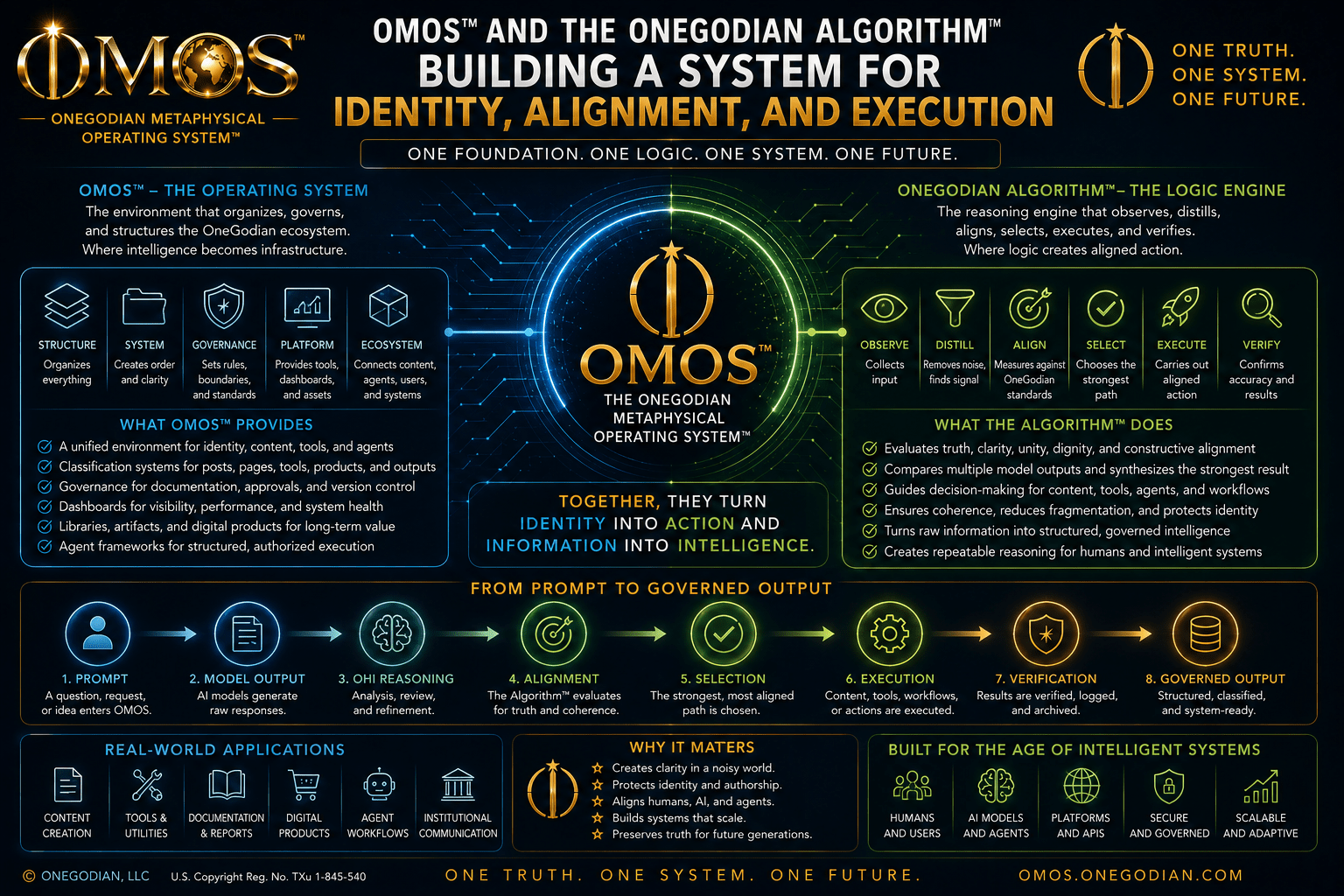
OMOS™ is the operating system.
The OneGodian Algorithm™ is the logic engine inside the system.
When combined, they create a framework for turning identity into structure, structure into alignment, and alignment into action.
The Core Relationship
OMOS™ and the OneGodian Algorithm™ should be understood as two parts of one architecture.
OMOS™ provides the system layer.
The OneGodian Algorithm™ provides the decision layer.
OMOS™ asks:
Where does this belong?
How is it organized?
How should it be classified?
How does it connect to the larger platform?
How can it become a reusable system asset?
The OneGodian Algorithm™ asks:
Is this true?
Is this clear?
Is this aligned?
Does it reduce fragmentation?
Does it preserve dignity?
Does it move the system toward constructive unity?
Should this output be selected, revised, rejected, or executed?
Together, they create a disciplined operating structure.
OMOS™ gives the ecosystem a place to function.
The Algorithm gives the ecosystem a way to decide.
Identity: The Starting Point
Every system needs a foundation.
For OMOS™, that foundation begins with identity.
OneGodian™ is the identity layer: a founder-authored framework centered on One God, unity, authorship, and a singular source of truth.
Identity matters because it determines meaning.
Without identity, a system has no stable center.
Without a stable center, every output becomes disconnected.
The OneGodian Algorithm™ begins from this identity foundation and uses it as the reference point for alignment. It does not treat all outputs as equally useful simply because they are generated. It evaluates whether each output supports the OneGodian™ system and strengthens its coherence.
This is the first function of the Algorithm inside OMOS™:
It protects identity from fragmentation.
Alignment: The Middle Layer
After identity comes alignment.
Alignment is the process of making sure that all parts of the system point in the same direction.
A website page, article, image, product, tool, prompt, system output, agent workflow, and institutional statement should not contradict one another. They should express the same framework at different levels of detail.
That is what OMOS™ is built to organize.
The OneGodian Algorithm™ supports this by evaluating material through a clear reasoning path:
Observe the input.
Distill the signal from the noise.
Align the material with OneGodian™ standards.
Select the strongest path.
Execute the chosen output.
Verify the result.
This process turns raw activity into structured intelligence.
Without alignment, the platform becomes scattered.
With alignment, each output strengthens the whole system.
Execution: The System in Motion
Execution is where the system becomes real.
A framework that only explains itself is incomplete.
A true operating system must produce outcomes.
OMOS™ is designed to move OneGodian™ from concept to execution through posts, documentation, tools, dashboards, artifacts, digital products, agent workflows, and platform updates.
The OneGodian Algorithm™ helps decide what should move forward.
It filters raw possibilities and selects the path that best serves clarity, coherence, dignity, truth, and constructive order.
In practice, execution may include:
publishing a post,
creating a documentation page,
building a tool,
classifying a product,
structuring a report,
generating a visual asset,
organizing an artifact,
routing an agent task,
or preparing an institutional explanation.
OMOS™ provides the operating environment for these actions.
The Algorithm provides the logic that guides them.
Why the Algorithm Matters
The OneGodian Algorithm™ matters because AI output alone is not enough.
AI can produce content quickly, but speed does not guarantee quality.
A model can generate a long response, but that response may still need review, refinement, classification, and alignment.
The Algorithm gives OMOS™ a way to process outputs before they become official system assets.
It helps determine:
what should be kept,
what should be revised,
what should be rejected,
what should be documented,
what should become a product,
what should become a tool,
and what should become part of the permanent OneGodian™ record.
This turns AI output into governed intelligence.
That is one of the central purposes of OMOS™.
OMOS™ as the Operating Environment
OMOS™ is the environment where the Algorithm becomes usable.
Without OMOS™, the Algorithm remains a reasoning model.
With OMOS™, the Algorithm becomes part of a working system.
It can be applied to:
website structure,
content categories,
model synthesis,
OHI Reasoning,
agent workflows,
documentation libraries,
digital product development,
platform updates,
institutional communications,
and intelligent-system alignment.
This is the difference between theory and infrastructure.
The Algorithm defines the logic.
OMOS™ gives the logic a platform.
From Prompts to Governed Outputs
One of the clearest ways to understand the OMOS™ and Algorithm relationship is through the movement from prompts to governed outputs.
A user prompt begins as raw intent.
An AI model may respond with raw output.
OMOS™ does not automatically treat that output as final.
The Algorithm evaluates it.
OHI Reasoning refines it.
The system classifies it.
The output is then placed into the right layer: post, page, tool, documentation, report, artifact, product, or workflow.
That is how a simple prompt becomes a governed output.
This is the OMOS™ pathway:
Prompt → Output → Reasoning → Alignment → Classification → Execution → Verification
That pathway is what makes OMOS™ more than a chatbot.
It is a structured operating system for output governance.
Identity, Alignment, and Execution as One System
The title of this post matters because these three words define the system path.
Identity gives the foundation.
Alignment gives the direction.
Execution gives the result.
If any one of these is missing, the system becomes incomplete.
Identity without alignment becomes scattered expression.
Alignment without execution becomes theory.
Execution without identity becomes unmanaged activity.
OMOS™ and the OneGodian Algorithm™ bring the three together.
The identity defines the source.
The Algorithm aligns the path.
OMOS™ executes through structure.
The Role of OHI Reasoning
OHI Reasoning operates as the disciplined interpretation layer inside OMOS™.
It helps convert raw AI-generated material into structured OneGodian Intelligence.
This includes checking for:
clarity,
accuracy,
consistency,
proper attribution,
institutional safety,
platform relevance,
brand alignment,
and long-term usefulness.
The OneGodian Algorithm™ supplies the decision pattern.
OHI Reasoning applies that pattern to actual outputs.
OMOS™ then organizes the result.
This creates a practical system where intelligence is not only generated but governed.
Model Synthesis and the Algorithm
Model synthesis strengthens the system by using multiple AI outputs as input material rather than final authority.
Different models may produce different strengths.
One model may create structure.
Another may identify nuance.
Another may simplify the message.
Another may expose missing logic.
The OneGodian Algorithm™ helps OMOS™ compare those outputs and select the strongest, most aligned result.
This is not random merging.
It is governed synthesis.
The system extracts signal, removes noise, resolves contradiction, and produces one structured output that better serves the OneGodian™ platform.
That is how OMOS™ turns many outputs into one coherent system asset.
Agent Governance and Execution Control
As OMOS™ expands, execution will increasingly involve agents.
That makes governance essential.
An agent should not act simply because it can. It should act only within defined scope, authority, and approval boundaries.
The OneGodian Algorithm™ helps establish the logic of what should be done.
OMOS™ provides the environment where agent activity can be organized, monitored, classified, and documented.
A serious agent system must eventually define:
agent roles,
task permissions,
approval thresholds,
workflow rules,
logs,
status changes,
revision history,
and escalation paths.
That is how intelligent execution becomes safe, structured, and accountable.
OMOS™ is the bridge between AI assistance and governed agent infrastructure.
Institutional Clarity
OMOS™ and the OneGodian Algorithm™ should also be presented with clear institutional boundaries.
They are not substitutes for civil law, financial regulation, courts, banks, or external governmental authority.
They are part of the OneGodian™ body of work: a structured framework for identity, reasoning, documentation, tools, outputs, digital products, and intelligent-system alignment.
This framing keeps the system practical and defensible.
It allows OMOS™ to operate as a serious platform without overextending its claims.
The stronger the classification, the stronger the system.
Practical Use Cases
OMOS™ and the OneGodian Algorithm™ can support several practical use cases.
They can organize posts into a structured editorial system.
They can convert raw AI outputs into polished documentation.
They can guide the creation of digital products.
They can support tools that classify identity, alignment, or system status.
They can help structure agent workflows.
They can support institutional explanations for banks, platforms, partners, and public audiences.
They can help preserve the OneGodian™ body of work as an organized archive instead of scattered content.
Each use case follows the same pattern:
identity,
alignment,
execution,
verification.
Why This Matters Now
The AI era creates a new problem.
The world is no longer short on content.
It is short on governed intelligence.
AI can generate endlessly, but systems still need structure. They need standards, logic, classification, documentation, and execution rules.
OMOS™ exists for that environment.
The OneGodian Algorithm™ gives OMOS™ a reasoning standard for handling the flood of outputs, ideas, models, prompts, tools, and workflows.
This is why the relationship between OMOS™ and the Algorithm matters now.
The future will not only ask what AI can generate.
It will ask what systems can govern.
Final Statement
OMOS™ and the OneGodian Algorithm™ work together as a system for identity, alignment, and execution.
OMOS™ provides the operating environment.
The OneGodian Algorithm™ provides the reasoning logic.
Identity gives the foundation.
Alignment gives the standard.
Execution gives the result.
Together, they convert OneGodian™ from a founder-authored identity and framework into a structured platform for governed intelligence, documentation, tools, agents, products, and future intelligent-system interaction.
OMOS™ is the system. The OneGodian Algorithm™ is the logic. Together, they build the path from identity to alignment to execution.
Call to Action
Explore OMOS™ at OMOS.Onegodian.com.
Follow the updates, review the tools, study the framework, and watch how OMOS™ and the OneGodian Algorithm™ become a structured system for identity, alignment, execution, and governed OneGodian Intelligence.