

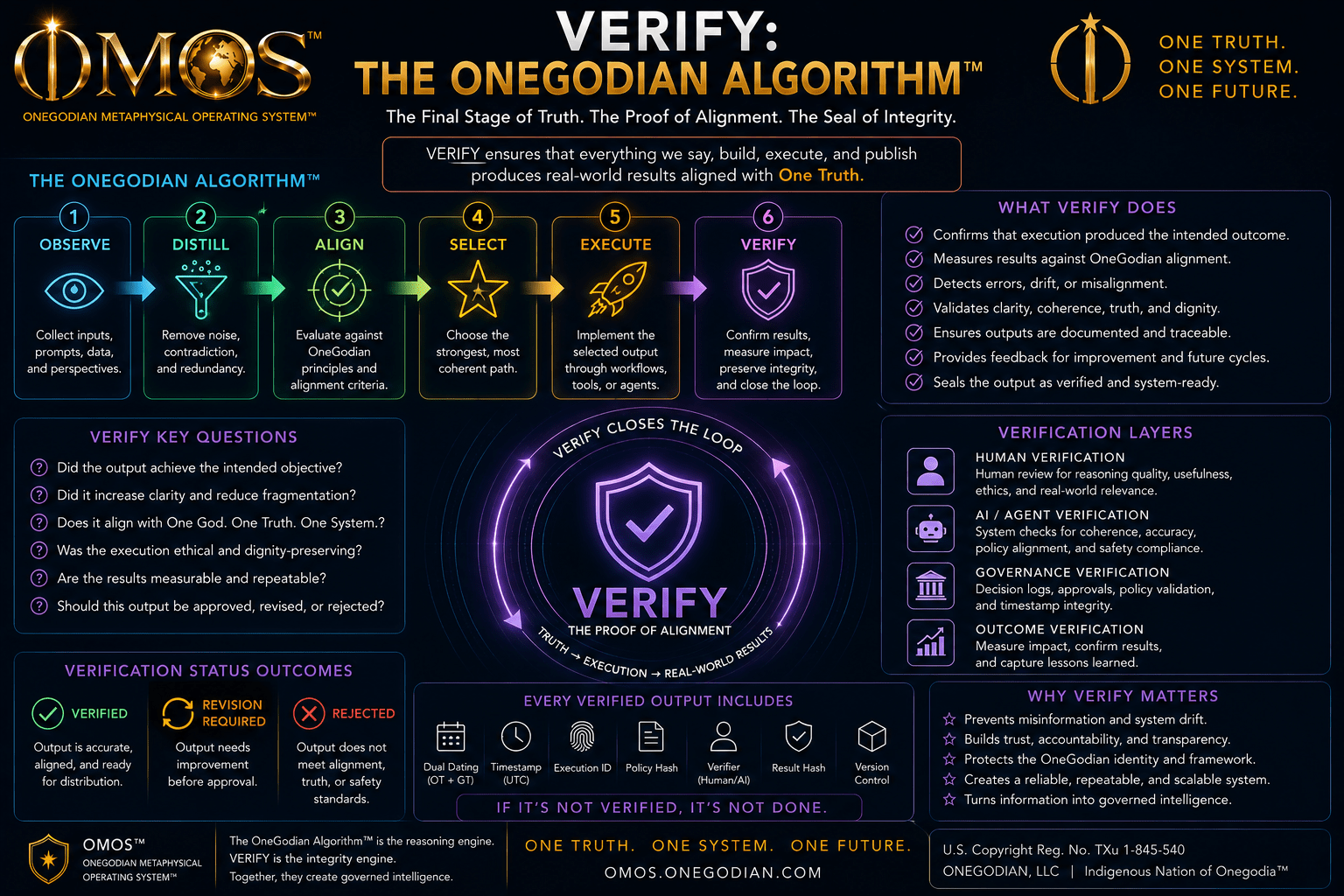
Verify: OneGodian Algorithm
Verify: The OneGodian Algorithm™
This OMOS™ post covers the Verify phase within the OneGodian Algorithm™ and its role inside the broader OMOS™ framework.
In the OneGodian Algorithm™, Verify is the final operational stage following:
- Observe
- Distill
- Align
- Select
- Execute
- Verify
The Verify phase exists to ensure that outputs, decisions, actions, or system behaviors are measured against reality, coherence, and documented intent after execution.
What “Verify” Means in the OneGodian Framework
Within the OneGodian Algorithm™, verification is not treated as optional review. It is a required governance and integrity layer used to determine whether an executed action actually produced:
- greater clarity
- stronger coherence
- reduced fragmentation
- truthful alignment
- durable outcomes
- measurable integrity
The framework defines verification through questions such as:
- Did the result improve clarity?
- Did it reduce distortion?
- Did it preserve dignity and constructive order?
- Did the implementation remain aligned with the original governing principle?
- Is correction or refinement required?
Verification as an OMOS™ Operating Principle
Inside OMOS™, Verify functions as a system integrity checkpoint.
The purpose is to prevent:
- uncontrolled drift
- hallucinated conclusions
- unverified assumptions
- fragmented execution
- policy inconsistency
- unmanaged AI behavior
This aligns directly with the OMOS architecture principle that outputs must be:
- observable
- governed
- reviewable
- versioned
- auditable
Verification Layers in the OneGodian System
1. Human Verification
Human verification evaluates:
- reasoning quality
- ethical coherence
- practical usefulness
- alignment with intended purpose
This is the reflective layer of the algorithm.
Example:
A person asks:
“Did this decision actually create order, clarity, and constructive unity?”
2. AI / Agent Verification
For AI systems and autonomous agents, Verify acts as:
- an output validation layer
- a coherence check
- a policy confirmation stage
- a conflict reduction mechanism
The system compares generated outputs against:
- truthfulness
- coherence
- safety rules
- alignment criteria
- governance policies
3. Governance Verification
Within ACC™ and agent-governed infrastructure, verification includes:
- decision logging
- authority validation
- policy hash confirmation
- execution tracking
- timestamp integrity
- audit records
The governance layer requires deterministic logging and approval tracking for sensitive actions.
The Verification Logic
The Verify stage asks:
Did the selected path produce the highest constructive coherence after real-world execution?
The algorithm measures outcomes against:
Positive Alignment Signals
- truth
- clarity
- coherence
- dignity
- constructive unity
Negative Signals
- distortion
- fragmentation
- manipulation
- unnecessary conflict
- instability
Verification in Multi-Model Synthesis
Within OMOS™, verification is also used in comparative AI synthesis.
Multiple models may generate different outputs. The system then:
- compares responses
- removes contradictions and noise
- identifies shared signal
- synthesizes the highest-coherence result
This process aligns with the GCD (Greatest Common Divisor) synthesis logic described in the framework.
The goal is:
unity from diversity through disciplined verification.
Why Verification Matters
Without verification:
- execution becomes unstable
- AI outputs become unreliable
- systems drift from purpose
- authority cannot be audited
- alignment cannot be measured
Verification transforms OMOS™ from:
- theoretical philosophy
into: - governed operational infrastructure.
Short Definition
Verify in the OneGodian Algorithm™ is the process of validating whether an executed action, AI output, or system decision produced truthful, coherent, measurable, and constructive results aligned with the governing principle of unity and integrity.
OMOS™ Principle
Observe the signal.
Distill the noise.
Align the path.
Select the action.
Execute with structure.
Verify against reality.
There are no comments